 ClassMori
Teaching articles
25 Classroom Brain Breaks for Elementary Focus: 3-Minute No-Prep Guide

The biggest mistake with classroom brain breaks is running the same high-volume jumping video whether your students are half-asleep after lunch or already bouncing off the walls after PE. When you match a two-to-three-minute zero-prop activity to your room's exact arousal level—waking up sluggish alertness with cross-lateral puzzles or grounding post-recess energy with slow isometric pushes—thirty pairs of eyes lock back onto the lesson without costing you ten minutes of instructional time.
Every activity below is teacher-led in `120–180 seconds` right beside student desks (for 15-minute free-choice rainy-day play, see our 32 calm indoor recess games guide), complete with a state-by-state decision chart, a podium transition script, and a Monday-through-Friday rotation plan.
Energize or Calm Down? How to Pick 3-Minute Classroom Brain Breaks
Whether a movement break actually sharpens learning depends on cognitive engagement and physiological fit. Classroom trials show brief exercise breaks significantly boost fourth- and fifth-graders' on-task behavior upon returning to seats (Howie, Beets, & Pate, 2014), and controlled comparisons confirm that breaks requiring rule-switching and motor coordination improve selective attention far more than mindless repetitive stepping (Schmidt, Benzing, & Kamer, 2016).
Those rule-switching micro-games tap the three core prefrontal executive functions identified by developmental psychologist Adele Diamond (2013): inhibitory control (resisting an automatic habit), working memory (holding and reversing a sequence), and cognitive flexibility (adapting on the fly when rules flip). Scan your room for five seconds before picking your prescription:
| Current Classroom State | Typical Window & Tell-Tale Signs | Matched Break Prescription | Duration & Landing Curve |
|---|---|---|---|
| Low-Alertness Slump | Right after lunch or gray afternoons; chins on palms, glazed eyes | Bilateral hand puzzles + opposite commands (`#1–#8`) | 150 sec · Build tempo, then freeze seated |
| Overhyped & Sweaty | Walking in from PE, music, or outdoor recess; flushed faces, loud chatter | Isometric muscle pushes + slow exhales (`#9–#16`) | 180 sec · Standing -> seated -> whisper |
| Mid-Block Mental Fatigue | Minute 22 of math or test review; pencil-spinning, fidgeting | Seated auditory recall + visual scan (`#17–#25`) | 120 sec · Zero standing; eyes land on page |
| Pre-Test Jitters | Morning of state/unit assessments or speeches; tight shoulders | Tense-and-melt contrast + 5-finger breath (`#14–#15`) | 120 sec · Warm, steady teacher cadence |
8 Energizing Bilateral & Opposite-Command Brain Breaks After Lunch
When eyelids droop at 1:15 p.m., asking the left and right hands to perform different jobs simultaneously—or asking students to do the opposite of your call—fires up prefrontal engagement in under a minute with zero running:
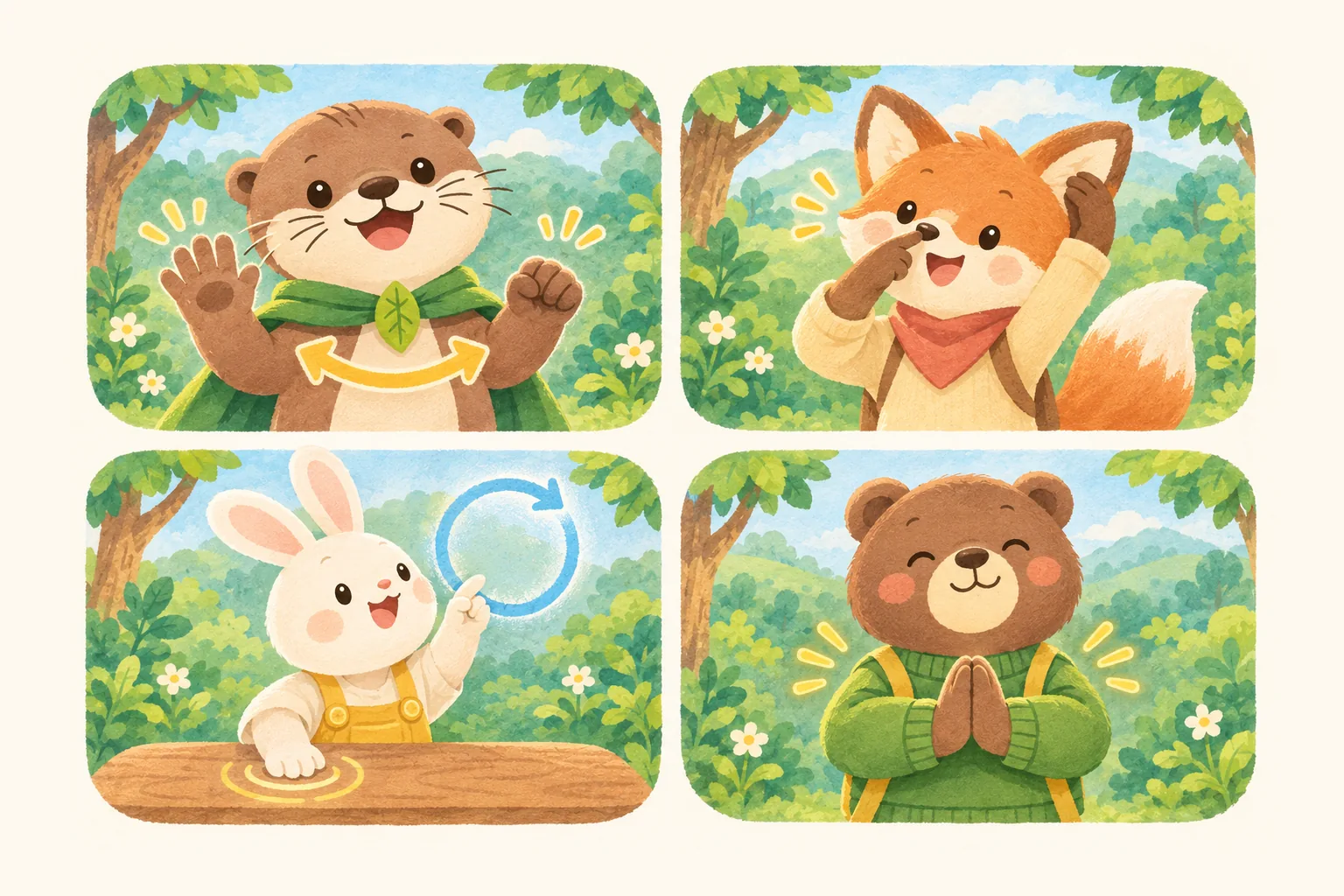
- Palm-and-Fist Rhythm Swap (Grades K–6 · Seated · Bilateral Coordination): Hold both hands at chest height—left palm flat open (`Paper`), right hand closed (`Rock`). Each time you tap your desk once, students instantly flip to left fist and right open palm; after ten steady beats, add a twist (`1 tap = swap, 2 taps = freeze!`).
- Nose-and-Ear Cross Clap (Grades 2–6 · Seated · Midline Crossing): Pinch nose tip with the left hand while reaching the right hand across to gently pinch the left earlobe. On each crisp clap, tap hands at chest center and land with right hand on nose, left hand crossing to right earlobe—smiling through mix-ups with zero elimination.
- Pat-and-Circle Split Brain (Grades K–6 · Seated · Asymmetric Motor Control): Right palm pats the thigh softly at a steady beat while the left index finger traces smooth clockwise circles in the air; call `"Switch!"` after ten seconds, or challenge upper grades to air-write their roster number while patting.
- Opposite-Action Caller (Grades K–6 · Standing Beside Desks · Inhibitory Control): Round 1 flips four basic cues (`"Stand up" = sit`, `"Sit down" = stand`, `"Look left" = look right`, `"Look right" = look left`). Round 2 adds `"Open hands / Close fists"`—wrapping up crisp after six calls.
- Silent Finger Traffic Light (Grades K–3 · Seated · Impulse Control): A zero-footsteps take on Red Light, Green Light: `"Green Light"` means ten fingers wiggle fast like a concert pianist in the air; `"Yellow Light"` slows hands to underwater astronaut motion; `"Red Light"` freezes every knuckle for three silent beats. For Pre-K through Grade 1 classes, pair this with rhythmic rhymes from our preschool fingerplays and primary action rhymes.
- Left-Hand-Beats-Right Solo RPS (Grades 3–6 · Seated · Cognitive Flexibility): Students play Rock-Paper-Scissors against themselves! On `"1, 2, 3, shoot,"` their left hand must beat their right hand (`right = scissors -> left must land as rock`); after three rounds, flip the rule so the right hand must win.
- Silent Make-Ten Finger Flash (Grades 1–4 · Seated · Working Memory + Number Sense): Hold up any number of fingers from `1` to `9` (say, `3`) without speaking; within two seconds, students silently hold up the partner number that makes `10` (`7`). Grab more ten-frame warm-ups in our first-grade make ten strategy math guide.
- Tai-Chi Mirror Conductor (Grades K–6 · Standing Beside Desks · Visual Tracking): Without saying a word, move your arms at ultra-slow underwater speed—one hand to crown of head, one thumb up, heels lifting one inch—while all thirty students mirror you in real time, gradually guiding everyone down into seated posture with hands resting on open books.
8 Proprioceptive & Slow-Breathing Resets After PE or Recess
Right after tag, scooter-board PE, or a windy recess, sympathetic nervous systems are revved high; barking `"Sit down and be quiet!"` fights biology. Guide the room down a smooth `180-second` landing ramp instead: slow standing stretch -> seated isometric muscle press (deep joint proprioception) -> extended visual exhale:

- Wind-in-the-Oaks Slow Sway (Grades K–4 · Standing · Down-Regulating Stretch): Feet glue to the floor like deep oak roots while arms lift like branches. `"Breezy wind"` sways arms wide and slow; `"Gentle whisper wind"` moves only fingertips; `"Calm forest"` floats hands down as students sink quietly into chairs.
- 5-Second Desktop Isometric Press (Grades K–6 · Seated · Upper-Body Proprioception): Sitting tall with both feet flat on the floor, students rest flat palms on their desktop and press steadily downward for five silent counts (shoulders relaxed, desks silent!), release for five counts, and repeat three times.
- Chest-Center Palm Push & Release (Grades K–6 · Seated · Core Grounding): Press palms firmly together at sternum height with elbows wide as you inhale through the nose, hold a steady five-second press, then exhale slowly while floating hands onto thighs.
- Chair-Edge Invisible Lift (Grades K–4 · Seated · Heavy-Work Input): Grip both sides of the chair seat with feet planted and gently press downward as if lifting torso one centimeter for four counts, or hug both knees snugly toward chest for five counts—a favorite for wiggly sitters.
- Cup-of-Hot-Cocoa Breathing (Grades K–4 · Seated · Extended Exhale): Skip clinical "diaphragmatic breathing" jargon—cup both hands in front of your mouth holding imaginary hot cocoa, inhale slowly through the nose for `3 counts` (`"smell the chocolate"`), and blow a long, gentle stream through pursed lips for `5 counts` (`"cool the cocoa without splashing"`).
- Five-Mountain Finger Tracing (Grades K–6 · Seated · Tactile Paced Breath): Spread one hand wide like five mountain peaks; trace the opposite index finger slowly up the outside of the thumb while inhaling and down the valley while exhaling—completing all five peaks in forty peaceful seconds.
- Tin Robot to Melting Snowman (Grades K–3 · Standing or Seated · Progressive Relaxation): On `"Wind-up robot!"` students clench fists, scrunch shoulders, and freeze stiff for three seconds; on `"Warm spring sun!"` they melt gradually from eyebrows to shoulders to floppy fingers resting on desks.
- 10-Exhale Heartbeat Check (Grades 3–6 · Seated · Interoceptive Reset): Eyes closed or soft downward gaze on one pencil eraser, one hand resting over the breastbone to notice heartbeat slowing across ten unhurried exhales before picking up pencils on ten.
9 Zero-Out-of-Seat Auditory Memory & Visual Search Games
During back-to-back core blocks—or whenever neighboring classes are testing—Harvard's Center on the Developing Child (2023) highlights short auditory sequence and visual rule-scanning games to refresh working memory without a single chair scraping the floor:
- 3-Second Delayed Rhythm Echo (Grades K–6 · Auditory Working Memory): Tap a 5-to-7-beat two-finger pattern on your palm; students must wait three silent beats holding the rhythm in mind before tapping it back in unison—training impulse restraint and recall together.
- Two Swapped Items on the Tray (Grades K–4 · Visual Short-Term Memory): Line up five desk supplies (highlighter, glue stick, magnet, clip, index card) under the document camera for ten seconds; students close eyes for five seconds while you remove one and swap two, then hold up fingers silently to show how many changed.
- Zero-Voice Thumb Simon Says (Grades K–6 · Silent Inhibitory Control): Nobody speaks a syllable! When you flash a thumbs-up first and then perform a gesture (touch chin, cross arms, hold up three), the class mirrors you; if you perform a gesture without flashing thumbs-up first, everyone stays frozen like statues.
- Three-Word & Four-Digit Reverse (Grades 2–6 · Backward Working Memory): Speak three everyday words calmly (`"backpack, pinecone, ruler"`); after a two-second pause, students whisper them back in exact reverse order (`"ruler, pinecone, backpack"`), scaling up to four digits (`3-8-1-6 -> 6-1-8-3`) for Grades 4–6.
- 10-Second Textbook Treasure Scan (Grades K–6 · Visual Scanning Into Lesson): Turn the upcoming textbook page into the game! Call `"Page 42—count every word with a double consonant and hold that number quietly against your chest!"` Ten seconds later, verify the count and launch straight into Paragraph 1.
- Silent Shoulder-Tap Current (Grades K–6 · Tactile Focus Relay): With eyes soft on desks, tap the back student in each row once on the shoulder; each student passes one feather-light shoulder tap forward up the row until Seat 1 raises a silent hand.
- Mystery Pencil-Tapper Compass (Grades K–4 · Auditory Localization): Heads down and eyes closed, walk quietly down an aisle and tap one student's desk; that student taps their pencil eraser twice on wood while you step back up front, and the class points silently toward the sound source before opening eyes.
- Sun-and-Moon Stroop Tap (Grades 3–6 · Interference Control): Sketch a Sun (pat knees once) and a Moon (fold hands) on the board, then deliberately point to the Sun while saying "Moon!"—challenging students to obey strictly where your finger points, not what your voice says.
- Partner Scratch-Paper Schulte Grid (Grades 1–6 · Visual Span Search): Students draw a quick `3 × 3` grid (numbers `1–9` scrambled for Grades 1–2) or `4 × 4` grid (`1–16` scrambled for Grades 3–6) on scratch paper and swap with their partner; on `"Go,"` tap `1 -> 16` in order using the eraser end of a pencil (leaving the grid clean to try beating their own time by two seconds!).
Use this quick-pick matrix when planning blocks:
| Break Prescription | Activity Numbers & Standouts | Executive Skill Targeted | Room Noise Rating |
|---|---|---|---|
| Post-Lunch Energizers (`#1–#8`) | Palm-Fist Swap, Nose-Ear Cross, Opposite Caller, Make-Ten Flash | Bilateral control, inhibition, flexibility | Light chuckles (1–2 Stars) |
| Post-PE Cooldowns (`#9–#16`) | Desktop Press, Palm Push, Hot-Cocoa Breath, 5-Mountain Trace | Proprioceptive grounding, vagal calm | Pin-drop calm (1 Star) |
| Testing-Safe Seated (`#17–#25`) | Delayed Echo, Thumb Simon Says, Textbook Scan, Schulte Grid | Auditory/visual working memory, scanning | 0–1 Star Silent |
How to Transition Back to Work in 10 Seconds + Weekly Rotation Chart
Many teachers skip movement breaks because they worry a three-minute game will trigger five minutes of rummaging through desks afterward. Flip one tiny step to eliminate transition drag forever: always have students open their workbook to the exact page and lay their pencil in the groove BEFORE standing up for the brain break. When the final slow breath finishes and students sit down, the page is already waiting right in front of them.
Keep novelty fresh without daily decision fatigue by rotating just five anchor breaks across the week:
| Day | Morning Mid-Block Reset (2 min) | Post-Lunch Slump Wake-Up (3 min) | Post-PE / Specials Cooldown (3 min) |
|---|---|---|---|
| Monday | Delayed Rhythm Echo (`#17`) | Palm-and-Fist Rhythm Swap (`#1`) | Desktop Press + Hot-Cocoa Breath (`#10 + #13`) |
| Tuesday | Zero-Voice Thumb Simon Says (`#19`) | Opposite-Action Caller (`#4`) | Oak-Tree Sway + 5-Mountain Trace (`#9 + #14`) |
| Wednesday | 10-Sec Textbook Treasure Scan (`#21`) | Nose-and-Ear Cross Clap (`#2`) | Chest Palm Push + 10-Exhale Check (`#11 + #16`) |
| Thursday | Silent Make-Ten Finger Flash (`#7`) | Left-Beats-Right Solo RPS (`#6`) | Chair-Edge Lift + Melting Snowman (`#12 + #15`) |
| Friday | Scratch-Paper `4 × 4` Schulte Grid (`#25`) | Tai-Chi Mirror Conductor (`#8`) | Silent Shoulder-Tap Current (`#22`) |
Tape the first card below to your podium corner, and drop the second snippet into your weekly family newsletter whenever parents ask how to help kids settle into after-school homework without screens:
STEP 1 — THE "OPEN BOOK FIRST" SETUP (Saves 5 Minutes Later!)
"Open math workbooks flat to page ___, rest pencils in the groove, and click water-bottle lids shut. As soon as every table is ready, stand right beside your chair for a 2-minute focus challenge!"

STEP 2 — THREE INSTANT LAUNCH CUES
- Sleepy Room (Energize): "Left hand open paper, right hand closed rock—swap cleanly on every desk tap. Ready... swap!"
- Sweaty Post-Recess Room (Calm): "Feet flat like oak roots, palms flat on your desktop—press steadily down for 5, 4, 3, 2, 1, and melt shoulders soft."
- Neighboring Class Testing (0-Decibel): "Zero-voice mode on: watch my thumb first—only mirror the move if you see thumbs-up!"

STEP 3 — THE 10-SECOND WHISPER LANDING (Drop Your Voice Volume Gradually)
"Take one last slow breath in... and as I count gently from 5 down to 1, sink all the way back into your chair with eyes on Question 1: 5... 4... 3... 2... 1... pick up pencils and circle the first number."
Dear Families,
If your child has a hard time settling down to start homework right after an after-school snack, try this quick 3-minute screen-free "Focus Warm-Up" before picking up a pencil:
1. Open today's assignment flat on the table first and clear away extra toys or screens.
2. Play 60 seconds of "Three Words Backwards" (you say "apple, backpack, bicycle," and your child repeats "bicycle, backpack, apple") to switch working memory on.
3. Do three slow "Palm Push + Cool the Hot Cocoa" breaths (press palms together for 5 seconds, then blow out gently for 5 seconds), and jump right into Problem #1!
FAQ
What 3-minute classroom brain breaks wake up sleepy students right after lunch?
Skip high-speed tag or loud chanting and run cognitively engaging bilateral coordination or opposite-command games—such as Palm-and-Fist Rhythm Swap, Nose-and-Ear Crossovers, or Opposite Action Caller. Inhibiting automatic impulses wakes up prefrontal alertness in 150 seconds without revving the room into chaos.
How do I calm my class down when they come back sweaty and loud from PE or recess?
Never launch a competitive speed game when heart rates are already sky-high. Run a 180-second Three-Step Cooldown Arc instead: 60 seconds of slow standing tree-sway stretches, 60 seconds of seated isometric desk-edge presses for grounding proprioceptive input, and 60 seconds of Hot-Cocoa slow exhales.
What quiet seated brain breaks work when the class next door is taking a test?
Use zero-out-of-seat working-memory and visual-scanning games: Delayed Rhythm Echo (wait 3 silent beats before tapping back), Zero-Voice Thumb Simon Says, Three-Word Reverse Recall, Textbook 10-Second Word Hunt, or partner scratch-paper Schulte number grids.
When is the best time to run a brain break during a 45-minute elementary block?
Younger elementary learners sustain focused listening for roughly 10 to 15 minutes, and upper grades for 15 to 25 minutes. Drop one crisp 2-to-3-minute break either right at arrival from recess (to down-regulate) or halfway through a block when shifting from direct mini-lesson to independent practice.
Can classroom brain breaks fix chronic attention challenges?
Three-minute movement and executive-function games are universal classroom management tools that refresh whole-group transitions—not diagnostic assessments or clinical interventions. When a student struggles persistently with attention or impulse regulation across settings for months, chunk tasks gently and collaborate with families and your school counselor or MTSS team.
Sources
- Classroom-Based Physical Activity Breaks and Children's Attention: Cognitive Engagement Works!Frontiers in Psychology2016
- Acute classroom exercise breaks improve on-task behavior in 4th and 5th grade students: A dose–responseMental Health and Physical Activity2014
- Activities Guide: Enhancing & Practicing Executive Function SkillsCenter on the Developing Child, Harvard University2023
- Executive FunctionsAnnual Review of Psychology2013