 ClassMori
Teaching articles
Classroom Calm Down Corner Ideas, 4-Step Peace Path & I-Messages

The most effective classroom calm down corner ideas turn abstract social-emotional learning into two physical routines elementary students can actually use when frustration spikes: a low-stimulation 3-minute reset nook and a 4-step floor Peace Path. When two sweaty kids storm back from kickball shouting over each other, playing courtroom judge ("Who touched the ball first?") eats fifteen minutes of math instruction and leaves everyone resentful. Below are five non-punitive setup essentials, a printable 3-minute student charter, 12 grade-leveled I-message replacement cards, a 36-word Emotion Thermometer, and clear safety boundaries for school-counselor referrals.
Emotion Storm vs. Testing Limits: How SEL Works in Real Classrooms
Social-emotional learning sticks when it lives inside everyday classroom routines rather than a once-a-month poster lesson. Analyzing 213 school-based universal SEL programs involving more than 270,000 students in *Child Development*, Durlak et al. (2011; CASEL, 2024) found that explicit practice in emotion recognition, self-regulation, and interpersonal problem-solving produces lasting gains in prosocial behavior and an 11-percentile-rank boost in academic achievement while reducing conduct issues and emotional distress.
In a busy room of twenty-eight kids, your biggest time-saver is distinguishing a physiological emotion storm from low-intensity limit testing or off-task behavior. When a student crumples a math test with flushed cheeks, sobs under a desk after feeling left out of a group, or clenches trembling fists after a recess foul, surging cortisol temporarily pulls the rational prefrontal cortex offline. Demanding "Explain yourself right now!" in that ninety-second window only escalates fight-or-flight.
| Classroom Moment | Signs of a Physiological Emotion Storm | Signs of Off-Task / Limit Testing | Teacher's First Response |
|---|---|---|---|
| Quiz handed back or error spotted | Flushed face, shallow breathing, tearing paper, silent tears | Spinning pencils, chatting across aisles, flicking eraser bits for laughs | Storm: offer a quiet 3-min reset before reviewing; Off-task: walk close and tap desk corner |
| Walking back in from recess | Trembling fists, breathless shouting ("He cheated!"), unable to listen | Jogging inside doorway, hiding a buddy's water bottle as a joke | Storm: sip water + 3 breaths before Peace Path; Horseplay: calm 20-second hallway redo |
| Small-group poster disagreement | Pushing chair back, covering ears, hiding face on arms | Grabbing all the markers or slumping back saying "This is boring" | Storm: invite 1 sand-timer flip in calm nook; Task hogging: clarify group roles and time limit |
| Missing supply or gentle reminder | Freezing up, frantic backpack digging, eyes welling with tears | Shrugging with a grin and grabbing a neighbor's scissors unasked | Storm: lend a spare pencil quietly; Unasked borrowing: prompt polite return and re-ask |
Whenever physical safety is secure, follow one sequence for emotion storms: regulate the body first, problem-solve the choices second. Waiting three quiet minutes turns a twenty-minute power struggle into a two-minute repair conversation.
Setting Up Calm Down Corner Ideas That Never Feel Like Time-Out
Classroom calm down corner ideas succeed or fail on one distinction: every student must experience the space as a brain-recharging pit stop, never a disguised penalty box. Calm corners typically backfire for one of two reasons: either a frustrated adult snaps, "Go sit in the calm corner and think about what you did!"—instantly poisoning the spot with shame—or the bin gets stuffed with LEGOs, plushies, and picture books, prompting four kids to line up for "sad breaks" the moment long division starts.
Tuck your nook into a semi-private back-side corner shielded from thirty staring pairs of eyes by a low L-shaped bookcase, while keeping an unobstructed sightline from your teaching easel and small-group table for continuous supervision.
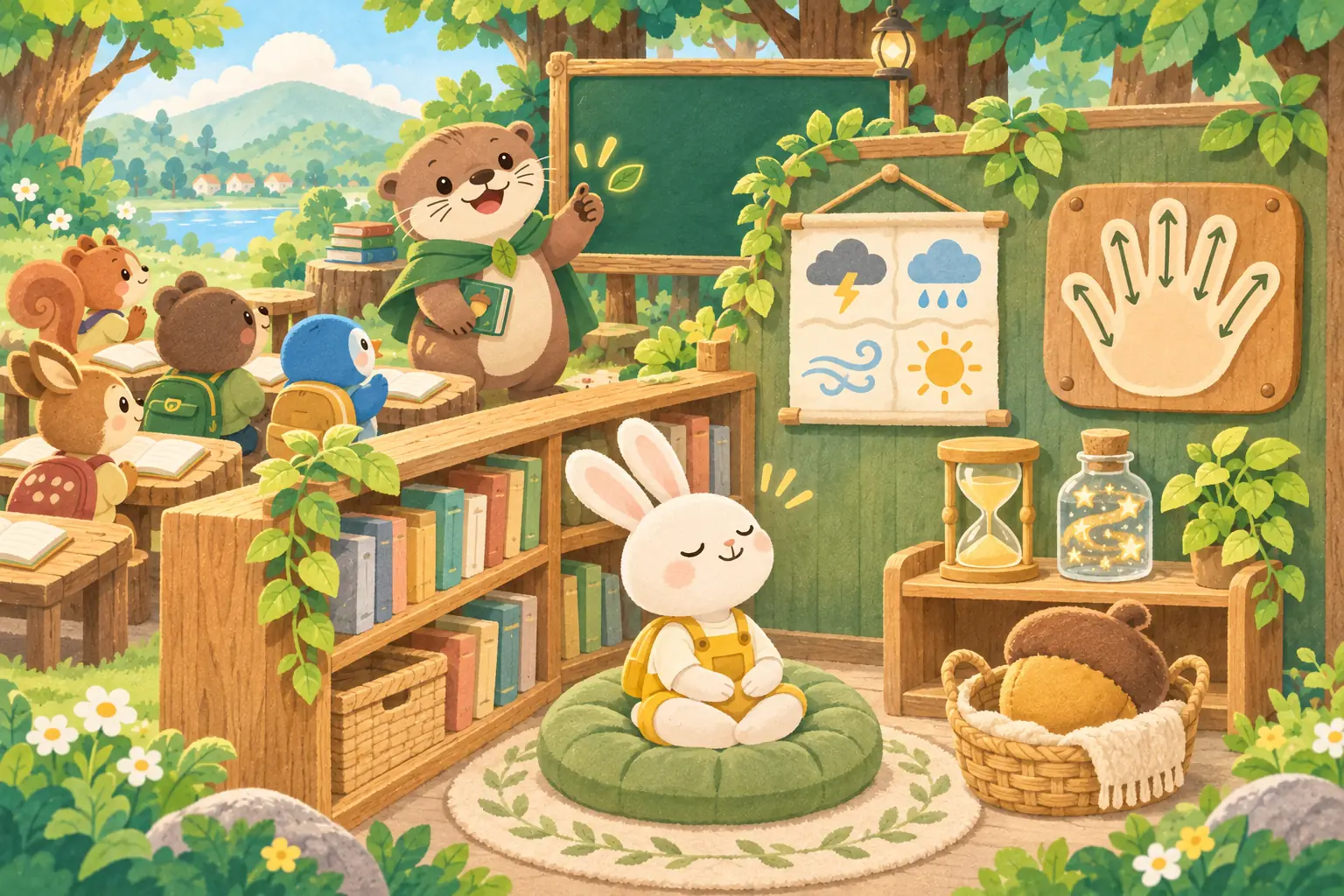
Keep sensory materials intentionally minimal—five silent, durable, low-cost items are all a K–6 reset nook needs:
| Setup Essential | Budget-Friendly Classroom Item | How It Calms the Nervous System | Pitfall to Avoid |
|---|---|---|---|
| Single Floor Cushion or Chair | Wipeable sage floor mat or one chair with felt floor glides | Marks a clear, contained boundary for one person to drop tense shoulders | Never place two seats—couches invite social lounging |
| 3-Minute Sand Timer or Glitter Jar | Shatterproof plastic 3-minute hourglass or sealed glue-and-glitter bottle | Watching slow-falling grains anchors visual focus and slows breathing | Seal bottle caps with hot glue; zero glass containers |
| 4-Zone Weather Feeling Chart | Laminated card showing Stormy, Rainy, Breezy/Cloudy, and Sunny icons | Lets a flooded child point to a feeling before speech comes back online | Never label emotions "good" or "bad"—all feelings are valid signals |
| Five-Finger Breathing Board | Sturdy cardstock hand outline (inhale up thumb, exhale down) | Turns abstract "calm down" advice into a concrete 60-second tactile trace | Practice tracing together as a whole class while everyone is happy |
| Silent Squeeze Ball + Water Sip | Soft felt acorn or foam stress ball (zero squeakers) + student's water bottle | Gives clenched hands safe proprioceptive release; sipping water interrupts sobbing | Zero noisy fidgets, toy cars, comic books, or tablet screens |
Five Golden Rules So It Never Becomes a Time-Out Chair
- Invite, never banish: Swap "Go to the calm corner now!" for a quiet side-by-side offer: "I notice your hands are shaking—would flipping the sand timer once help before we talk?"
- Use a silent desk pass for Grades 3–6: Older kids hate announcing they are about to cry. Give each table a small green laminated pass or teach a discreet two-finger tap on the chest so students can slip back without drawing an audience.
- One visitor at a time, capped at one 3-minute sand-timer flip: When the sand runs out, the student takes a breath and rejoins class (with one optional re-flip followed by a 30-second teacher check-in if still overwhelmed).
- Classwork waits kindly—it does not vanish: Clarify upfront that recharging your brain helps you finish hard things. The two remaining math problems still get completed afterward (with chunked teacher support if frustration came from academic confusion).
- Classmates practice "kind invisibility": Nobody stares, asks "Why were you back there?", or crowding around a peer returning to their seat.
Laminate this one-page student charter beside your nook during Week 1 and model a calm three-minute visit yourself:
OUR CALM-DOWN NOOK AGREEMENTS

1. WHEN CAN I VISIT?
Whenever my heart beats super fast, my face feels hot, or tears are coming—and I want 3 quiet minutes to help my brain cool down.

2. HOW MANY PEOPLE AT ONCE?
Just 1 student at a time. If a classmate is already there, I can rest my head on my arms for 5 slow breaths at my desk or signal my teacher.

3. WHAT 3 THINGS DO I DO HERE?
- Flip the 3-minute sandglass (or swirl the glitter bottle) once and watch it settle.
- Trace the Five-Finger Breathing Board slowly (breathe in going up, breathe out going down).
- Point to the Weather Chart and name how my body feels right now.

4. WHEN DO I HEAD BACK?
When the sand finishes falling, I tidy the pillow, take a sip of water, and return to my seat ready to finish my learning step by step.

5. HOW DO CLASSMATES HELP?
We give quiet privacy—no staring, no teasing, and no asking questions while a friend resets.
Stop Playing Courtroom Judge: The 4-Step Peace Path and 12 I-Messages
Everyday peer spats—disputed four-square outs, unasked eraser borrowing, accidental line bumps, or bossy project partners—become powerful SEL reps when students walk a structured 4-Step Peace Path on their own. Türk's (2017) meta-analysis of school conflict-resolution and peer-mediation programs found robust positive effects (*d* = 0.76) on constructive student problem-solving, substantially cutting physical aggression and adult intervention time.
Tape four symmetrical pairs of non-slip vinyl leaf decals (or lay a four-panel runner) along a quiet side wall. Once both students are physically unhurt and out of red-zone shouting, have them stand at opposite ends facing each other and step inward one pad at a time:

- Step 1 (Outer Sky-Blue Pads — Cool & Commit): Both students take three slow belly breaths and silently agree: "No interrupting, no name-calling—we want to solve this." Anyone still yelling takes a 3-minute sand-timer reset first.
- Step 2 (Coral Pads — Share I-Messages & Mirror Back): Speaker A states what happened and how they felt using an I-message while Speaker B listens with hands still; Speaker B briefly summarizes ("So you felt frustrated when...") before taking their turn.
- Step 3 (Honey-Yellow Pads — Brainstorm Fair Fixes): Each person suggests one realistic way to repair right now or handle next time fairly (re-do the disputed serve, pick up the spilled crayons together, split poster drawing 50/50).
- Step 4 (Center Green Star Pad — Agree & Repair): Step onto the center star once both nod yes to a plan—seal it with a wave, thumbs-up, high-five, or immediate cleanup action (never force hugs).
12 Grade-Banded "I-Message" Replacement Scripts
Arguments spiral when kids lead with accusing "You-messages" (*"You always ruin everything!"*). Anchor this poster beside your Peace Path and rehearse two pairs a week so students have ready-made words under stress:
CORE FORMULA: "When you ____ (fact), I felt ____ (feeling), and next time please ____ (fair action)."

PART 1: GRADES K-2 (Short, concrete—sharing, line space & accidental bumps)
1. Taking Supplies Without Asking
   Instead of: "You stole my blue crayon! Teacher, he took it!"
   Say: "When you grabbed my blue crayon without asking, I felt upset. Please ask me before borrowing."
2. Crowding or Stepping on Shoes in Line
   Instead of: "Quit shoving me! Move back!"
   Say: "When you stood super close and stepped on my heel, it hurt. Please leave one arm of space."
3. Accidental Ball Hit at Recess
   Instead of: "You hit me on purpose! You're mean!"
   Say: "When that kickball hit my arm hard, it really stung and scared me. Please check if I'm okay first."
4. Knocked-Over Block Tower or Craft
   Instead of: "You wrecked my whole tower! You can't play!"
   Say: "When your elbow knocked down the blocks I stacked, I felt sad. Please help me build the base back up."

PART 2: GRADES 3-4 (Game rules, group fairness & teasing boundaries)
5. Disputed Boundary Line Call at Recess
   Instead of: "You're such a cheater—that ball was totally out!"
   Say: "We saw that line call differently and arguing is eating up recess. Let's call a do-over on that serve."
6. Taking Over a Partner Poster
   Instead of: "You're so bossy, you never let anyone else draw!"
   Say: "When you picked the title and drew all the pictures yourself, I felt left out. Let's divide the poster in half."
7. Joke or Nickname Going Too Far
   Instead of: "Shut up, nobody thinks you're funny!"
   Say: "When you joked about my last name, I felt embarrassed. Please call me by my real name."
8. Uneven Cleanup Chore Effort
   Instead of: "I'm not sweeping anymore—he's just goofing off!"
   Say: "When I swept our table pods alone while you chatted, I felt frustrated. Please hold the dustpan for this half."

PART 3: GRADES 5-6 (Privacy, group deadlines, rumors & digital respect)
9. Looking Through Someone's Sketchbook or Desk
   Instead of: "What is wrong with you? Stay out of my stuff!"
   Say: "When you flipped through my notebook without permission, I felt disrespected. Ask me first if you want to see a drawing."
10. Falling Behind on a Shared Slide Deck
    Instead of: "You never do any work and you're tanking our grade!"
    Say: "With presentations tomorrow and Slides 3 and 4 still blank, I'm stressed. Let's use the next 10 minutes to finish your section together."
11. Secondhand Gossip Misunderstanding
    Instead of: "Why are you talking trash about me behind my back?"
    Say: "Someone told me you were upset with me after lunch, and I felt confused. If something bothered you, let's talk directly."
12. Unwanted Photo or Group-Chat Comment
    Instead of: "Delete that right now or you're dead!"
Say: "Posting that blurry photo without asking made me really uncomfortable. Please delete it now and check with me before taking pictures."2-Minute Daily Practice: Emotion Thermometer & Read-Aloud Prompts
Self-regulation sticks best when practiced for two calm minutes while nobody is upset. Tie daily feeling check-ins directly into your morning meeting questions and arrival flow using the clothespin weather chart: one glance before 8:15 a.m. tells you whose family dog got sick last night or who skipped breakfast so you can offer quiet grace all morning.
Many elementary students shout "I'm mad!" or "This is stupid!" simply because they lack precise vocabulary for embarrassment, overwhelm, or disappointment. Post this 36-word Weather Emotion Thermometer beside both your calm nook and your writing center—it upgrades conflict resolution and narrative character writing at the same time:
| Zone & Weather Icon | Common Body Clues | Primary Words (Grades K–2: 12) | Upper-Elementary Nuance Words (Grades 3–6: 24) |
|---|---|---|---|
| Green Zone · Warm Sun (Calm, focused, ready to team up) | Steady breath, relaxed jaw, soft shoulders, open posture | Happy, calm, safe, proud | Content, focused, hopeful, appreciated, confident, curious |
| Blue Zone · Gentle Rain (Low energy, tired, needing comfort) | Yawning, heavy sighs, head on desk, quiet voice | Sad, sleepy, lonely, hurt | Drained, disappointed, left out, discouraged, homesick, gloomy |
| Yellow Zone · Gusty Clouds (Wiggly, tense—time for a small check) | Fidgeting, tight pencil grip, fast talking, furrowed brow | Worried, nervous, wiggly, stuck | Overwhelmed, embarrassed, impatient, uneasy, frustrated, flustered |
| Red Zone · Thundercloud (Flooded—pause & cool down first) | Hot cheeks, racing heart, clenched fists, urge to yell/throw | Mad, furious, scared, bursting | Enraged, humiliated, panicked, defensive, betrayed, explosive |
During ELA read-alouds or chapter-book discussions, skip moralizing ("Was the main character good or bad?") and weave in two of these five perspective-taking questions:
1. BODY CLUE DETECTIVE: Right before that argument happened, what physical clue in the character's hands, face, or voice showed their emotion thermometer rising?
2. UNDER THE ICEBERG: On the surface the character sounded angry—what quieter feeling (worry, embarrassment, fear of losing a friend) might be hiding underneath?
3. CAMERA FLIP: If we retold this exact page from the other character's seat, what did things look like through their eyes?
4. THREE-SECOND REWIND: If you could hit pause three seconds before those hurtful words came out, which calm-down strategy would have helped most?
5. REAL REPAIR: Now that feelings are bruised, what specific action—not just a quick "sorry"—would help rebuild trust between them?
Show families a quick photo of your calm nook and Peace Path during fall Back-to-School Night—see our parent teacher conference tips for slide wording—so parents know that hearing "I used the calm corner for three minutes today!" celebrates mature self-awareness rather than getting in trouble.
When Peer Mediation Stops: Bullying, Crisis Signs, and Referral Resources
A classroom Peace Path is strictly for isolated, equal-power everyday disagreements. Whenever a situation involves repeated targeting, a power imbalance, physical injury, harassment, self-harm talk, or suspected child abuse or neglect, never place students face-to-face on a Peace Path or pressure them to shake hands. Forcing a targeted student to "work it out" alongside an intimidator compounds harm and silences reporting.
Use this four-column triage matrix whenever an incident feels heavier than a typical recess spat:
| Triage Dimension | Everyday Peer Conflict (Peace Path OK) | Bullying or High-Risk Red Flag (NO Peer Mediation) | Immediate Teacher Protocol |
|---|---|---|---|
| Frequency & Target | Occasional spat over a ball or turn; partners vary | Repeated teasing, exclusion, cyber-mockery, or extortion aimed at one child | Separate students calmly; document objective facts; notify principal/dean & school counselor |
| Power Balance | Similar age, social standing, and voice | Group-against-one, size/status gap, or target visibly afraid to speak | Prioritize target's safety; listen 1-on-1 privately; follow school anti-bullying policy |
| Post-Incident Stance | Both feel remorse once calm and want to repair | Zero remorse, blaming victim ("Just a joke!"), or ongoing intimidation | Enforce clear behavioral consequences; never ask target to accept a forced apology |
| Well-Being & Safety Signals | Returns to normal play and learning after cooling | Unexplained bruises, hopeless/self-harm statements, sudden withdrawal | Escort/keep student supervised; alert school counselor, nurse, or social worker immediately |
Whenever any bump leaves a scrape, torn sleeve, or lingering tears, call both families before dismissal so parents hear your calm, proactive voice before seeing a bandage at pickup—grab ready-to-use phone and note wording in our letter to parents from teacher templates.
FAQ
How do I keep a classroom calm corner from turning into punishment or work avoidance?
Set three non-negotiable norms on Day 1: first, never bark 'Go to the calm corner!' in anger—offer it only as a supportive invitation; second, stock only regulatory tools (sand timer, breathing board, feeling chart), zero toys, iPads, or comic books; third, cap visits at one 3-minute sand-timer flip, after which the original classwork still gets completed.
What should I say first when two students burst in from recess crying and blaming each other?
Skip 'Who started it?'—that triggers instant defensiveness. Speak slowly in a low, steady voice: 'I see both of you are really upset right now. First, is anyone physically hurt? Good—take a sip of water and three slow breaths. Once our hearts slow down, both of you will get uninterrupted time to share what happened.'
How do I teach K-4 students to use I-messages instead of name-calling or tattling?
Post a color-coded sentence frame right beside your Peace Path: 'When you ____ (observable fact), I felt ____ (emotion word), and next time I need you to ____ (concrete action).' Practice swapping common recess complaints during Morning Meeting with puppets or role-play while everyone is calm so the phrasing feels natural mid-conflict.
How do I tell normal peer conflict apart from bullying—and when do I involve the school counselor?
Everyday conflict happens between peers of similar standing who feel remorse once calm. Bullying involves repeated harm, a clear power imbalance, and intent to exclude or demean. Never force face-to-face apologies for suspected bullying, self-harm disclosures, or abuse indicators; separate students safely, loop in your school counselor and principal immediately, and follow mandated reporting protocols.
Sources
- The Impact of Enhancing Students' Social and Emotional Learning: A Meta-Analysis of School-Based Universal InterventionsChild Development2011
- Evaluation of the Effects of Conflict Resolution, Peace Education and Peer Mediation: A Meta-Analysis StudyInternational Education Studies2017
- Fundamentals of SELCollaborative for Academic, Social, and Emotional Learning (CASEL)2024
- 988 Suicide & Crisis Lifeline — Youth & Educator ResourcesSubstance Abuse and Mental Health Services Administration (SAMHSA)2024