 ClassMori
Teaching articles
Classroom Seating Chart Ideas: 4 Desk Layouts and Zero-Drama Grouping

The most effective classroom seating chart ideas match desk layouts to the learning task—paired rows for independent focus and pinwheel pods or double U-shapes for discussion and labs. Lock in board sightlines, four-step teacher walk loops, sensory priority seats, and diagonal talk buffers first, then run a predictable three-minute monthly rotation so desk moves never derail your afternoon.
Classroom Seating Chart Ideas Start with 4 Non-Negotiable Room Checks
How you angle twenty-eight desks quietly shapes how easily kids read phonics slides, how fast whispers spread across aisles, and how many seconds it takes you to tap a stuck student's paper. Synthesizing empirical K–12 seating studies in Support for Learning, Wannarka and Ruhl (2008) found a clear rule of thumb: no single seating layout wins across every task—rows significantly boost on-task behavior during independent seatwork (especially for distractible learners), whereas clusters and semicircles raise participation when brainstorming and peer talk are the goal.
Interviewing fifty upper-elementary teachers (Grades 4–6), Gremmen et al. (2016) likewise documented that teachers juggle between 2 and 19 competing academic, social, and physical constraints on every chart. Before dragging names onto a grid, check four physical non-negotiables:
- Zero backs to the projector (<= 45-degree neck turn): Never seat a child with their back to the front board. When building four-desk pods, orient desks perpendicular to the whiteboard in a sideways pinwheel so every student glances right or left to copy notes without craning 180 degrees.
- The 4-step teacher proximity loop: From the center of the room, you should be able to reach every desk within four strides for quiet point-and-whisper coaching. Keep main aisles at least 24 inches clear by hanging backpacks on chair sleeves or storing them in cubbies.
- IEP, 504, vision, and sensory seats locked first: Before shuffling anyone else, anchor low-glare front-interior seats for students with glasses, auditory needs, or preferential seating plans—away from noisy hallway doors and humming AC vents.
- Buffer zones around high-traffic stations: Leave three feet of breathing room around pencil sharpeners, tissue boxes, and turn-in trays, and avoid placing your most easily distracted learners right beside the trash can or sink.
4 Proven K-6 Desk Layouts Compared: Rows, Pairs, Pods, and U-Shape
Most elementary rooms squeeze 24 to 30 desks around a meeting rug, kidney table, and classroom library. Compare the four workhorse layouts below to pick your default home base:
| Desk Layout | Best Instructional Fit | Sightline & Focus Pros | Classic Pitfall & Easy Fix |
|---|---|---|---|
| Single Columns (6×5 or 6×4 rows) | Independent writing, benchmarks, first 2 weeks of September | 100% forward sightlines, clear personal space, lowest off-task chatter | Hard to collaborate; pair front-to-back neighbors for quick turn-and-talks |
| Paired Columns (3 columns of 4–5 pairs) | Partner reading, math strategy checks, everyday K–5 homeroom | Forward view + built-in shoulder partner + wide center walk lanes | Best friends chat nonstop; pair steady anchors with high-energy peers |
| Sideways 4-Desk Pods (6–7 pinwheel islands) | STEM labs, literacy centers, art sharing, cooperative challenges | Easy shared caddies, natural eye contact, fast table scoring | Sideways chatter rises; pair with our classroom noise monitor guide |
| Double U-Shape / Horseshoe (outer + inner arc) | Morning Meeting debates, Socratic seminars, read-alouds, world language | Every student sees peers' faces; teacher reaches everyone from the center | Single U won't fit 30 desks; nest an 18-desk outer U around a 12-desk inner U |
The Zero-Scraping '30-Second Pair-to-Quad Pivot'
Hate choosing between calm rows during math modeling and four-person pods during science? Make 3 columns of paired desks your everyday setup:
- During direct instruction and independent writing, all 28 or 30 students face straight ahead in calm pairs—zero sideways neck strain.
- When group lab time starts, say "Odd rows, pivot!" Students in rows 1, 3, and 5 simply lift and turn their chairs 180 degrees to face the pair right behind them—forming instant four-person teams in thirty seconds without dragging a single desk leg across the tile.
- With 24 students, you get 6 clean quads; with 30 students, rows 1–4 form 6 quads while row 5 slides slightly inward to form two balanced trios.
Default Layout Picks by Grade Band
- Grades K–2: Start September in spaced rows or clearly taped pairs while six-year-olds learn where their own pencil box ends, then transition to paired desks after October routines settle.
- Grades 3–4: Paired columns with the 30-second chair pivot give third and fourth graders structure for independent stamina plus instant pods for hands-on investigations.
- Grades 5–6: Rotate between sideways pods and a double U-shape for humanities discussions, using the zero-login scoreboard or widgets from our free Classroomscreen alternatives to reward crisp pod transitions.
Seating a Chatty Class Without Isolating High-Energy Kids
By November, everyone in homeroom is friends with everyone—and every corner of the room wants to talk. Resist the temptation to exile an impulsive student to a solo "island desk" wedged beside the teacher's file cabinet or back corner: public isolation breeds defiance and turns that child into an across-the-room performer.
Use three dignity-safe spatial buffers instead:
- The Two-Desk Diagonal Rule: Separate duo comedians across a diagonal of at least two desks (e.g., front-left row 2 and mid-right row 4). Across-the-aisle and front-to-back neighbors still catch eye contact effortlessly; diagonal angles break visual ping-pong while keeping both kids inside normal pods.
- Rotating Steady-Anchor Partners: Avoid seating two high-impulse students shoulder-to-shoulder, and avoid burning out the same quiet girl as a permanent "helper buffer" all year. Rotate calm, focused classmates fairly every four weeks so nobody carries unfair social weight.
- The Interior T-Zone: Scatter the four to six students who need frequent check-ins along the front two rows and the two interior aisle seats—your natural walking T-zone—so a silent finger point to question #3 redirects focus mid-sentence without calling names aloud.
S-Curve 4-Person Grouping (Ending 'One Kid Does Everything')
Social interdependence research by Johnson and Johnson (2009) shows cooperative pods work only when positive interdependence pairs with individual accountability. Build balanced teams using an S-Curve + Numbered Seats (#1–#4):
Mentally sort your roster into four readiness quartiles (1–7, 8–14, 15–21, 22–28) and snake one student from each band into every four-person pod so neighbors can coach each other without huge frustration gaps. Next, number the four desk corners #1 to #4—tying #3 directly into your classroom jobs and student leaders supply routine:
POD TEAMWORK ROLES (Rotate +1 seat clockwise every 2 weeks)
Seat #1 — Discussion Host: Reads the task prompt aloud and invites every pod member to share one idea before writing.
Seat #2 — Chief Recorder: Writes or sketches the group's agreed answer clearly on the whiteboard or lab sheet.
Seat #3 — Materials Captain: Picks up and counts all group supplies, and stacks finished pod notebooks in order.
Seat #4 — Time & Voice Keeper: Watches the projector timer and taps two fingers if pod talk rises above Level 2.
Monthly Seat Rotation Cadence and a 3-Minute Zero-Chaos Move Script
Changing seats every three to four weeks (for instance, the first Friday afternoon of each month) balances visual fairness for kids on outer wings with predictable routine. Skip hand-erasing sticky notes—use a digital grid that lets you lock front-row accommodations and "keep apart" pairs before shuffling:
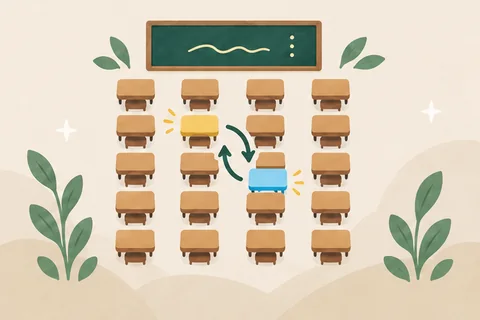 Free toolsSeating chart makerOpen a ready-to-go 30-seat chart with zero login: lock priority seats, keep chatty pairs apart, shuffle in one click, swap any two desks in two taps, and project or print.Open the tool
Need quick one-period lab partners without touching homeroom desks? Spin temporary teams in five seconds instead:
 Free toolsRandom groupsSplit student numbers 1 to 30 (or pasted names) into even teams of 2, 3, 4, or 5 in one tap—skipping absent students without overwriting your seating chart.Open the tool
The 3-Minute Zero-Chaos Seat Move Script
Desk moves turn loud only when twenty-eight kids grab loose crayons and charge in opposite directions at once. Project these three timed steps so the entire room relocates in 180 seconds flat:
STEP 1: PACK & HUG (60 Seconds)
Pack every loose notebook, folder, and pencil inside your pencil box or backpack, check the floor under your feet for stray caps, and hug your stack in your lap while seated.

STEP 2: TUCK & SPOT YOUR NEW HOME (30 Seconds)
Stand silently, push your chair gently under the desk, and stand right behind your OLD chair. Look at the projector map to find your new pod and seat number—feet stay planted until the chime!

STEP 3: CLOCKWISE MOVE & GREET (90 Seconds)
On the chime, walk in one smooth clockwise loop around the outer aisle to your new seat, unpack neatly, and turn to your new shoulder partner with a smile and high-five: "Glad to be tablemates this month!"
Once permanent table pods are set, importing that exact roster once lets you award whole-pod teamwork points in a single tap all month long.
FeaturesRoster import & class managementPaste or upload your Excel or CSV class list once to manage table groups, student numbers, and multiple classes—powering tools and points from one roster with zero student accounts.Learn moreFAQ
What are the best desk layouts for a classroom with 24 or 30 elementary students?
For 24 students, 3 columns of 4 paired desks, 6 angled four-person pods, or a single horseshoe with an inner row leave generous 24-inch walkways. For 30 students, 3 columns of 5 paired desks (pivoting into quads on demand), 6 four-person pods plus 2 trios, or a double U-shape (18 outer + 12 inner) prevent blocked aisles.
In what order should I place students when building a new seating chart?
Lock in three layers before randomizing the rest: (1) IEP, 504, vision, hearing, and sensory accommodations in low-glare front-center seats; (2) sightline angles so taller students sit along outer wings rather than blocking shorter peers; and (3) diagonal buffers separating high-distraction pairings.
How often should elementary teachers change the classroom seating chart?
Every three to four weeks—roughly the first Friday of each month or right after a unit benchmark—balances fresh social combinations and balanced left/right eye angles to the board without disrupting predictable daily routines. Avoid pure blind draws that accidentally seat vision-accommodated kids in the back.
How do I form 4-person groups so one student does not end up doing all the work?
Use S-curve heterogeneous grouping (1 High + 1 Mid-High + 1 Mid-Low + 1 Developing learner per pod) so adjacent peers can talk productively without wide frustration gaps, then assign seats #1 through #4 concrete roles—Facilitator, Recorder, Materials Captain, and Time/Voice Keeper.
How do I stop students from groaning or complaining when they see a new seating chart?
Teach a 'Zero-Sigh Kindness Norm' right before projecting the new map: every classmate deserves a welcoming face, so zero groans, thumbs-downs, or 'Aw, man!' comments earn an immediate whole-class point. Let students know genuine vision or glare concerns can be shared privately with you at recess.
Sources
- Seating arrangements that promote positive academic and behavioural outcomes: a review of empirical researchSupport for Learning2008
- Considerations for classroom seating arrangements and the role of teacher characteristics and beliefsSocial Psychology of Education2016
- An Educational Psychology Success Story: Social Interdependence Theory and Cooperative LearningEducational Researcher2009