 ClassMori
Teaching articles
Classroom Party Games and End-of-Term Guide: 6 Free Booths & Schedule
Whether you are celebrating the final Friday before winter break or wrapping up the school year in June, the best classroom party games avoid the two classic teacher nightmares: sugar-fueled chaos over a movie and thirty minutes of crushed pretzel crumbs left for you to sweep alone after dismissal. When you hand planning over to four student committees one week early and pace your eighty-minute block around zero-cost desk carnival booths, inclusive whole-class games, seated allergy-safe snacks, and a ten-minute restoration relay, everyone leaves smiling—including you.
Everything below works across Grades K–6 for any non-religious end-of-quarter, milestone, or end-of-year celebration, complete with a copyable Student Committee Planning Sheet, six zero-budget booth blueprints, a Family Allergy Return Slip, and peer shout-out card prompts.
Student-Led Planning Committees One Week Before Your Party
The secret to a calm celebration happens seven days before the party: shifting students from passive consumers waiting to be entertained into co-hosts with real responsibilities. Self-Determination Theory demonstrates that supporting students' autonomy, competence, and belonging strengthens intrinsic motivation and self-regulation (Ryan & Deci, 2000).
Rather than electing two popular class officers to do everything, divide all twenty-eight to thirty students evenly across four action crews so every child holds one concrete, visible job:
| Student Crew | Ideal Size | 3 Days Before the Party | Party-Day Core Role |
|---|---|---|---|
| Emcee & Timer Crew | 6–7 students | Draft transition script, sequence talent sign-ups, draw welcome banner on board | Co-host transitions, run the stopwatch, ring the quiet chime |
| Carnival Booth Crew | 8–9 students | Craft 6 station signs, fold paper rings, cut 4-stamp passport slips | Demo 30-second booth rules, host Shift 1 stations, stamp passports |
| Snack & Hygiene Crew | 7–8 students | Help teacher tally allergy slips, count napkins, prep serving tongs | Lead handwashing line, verify seated snacks, pass damp paper towels |
| Restoration Crew | 7–8 students | Stick painter's-tape desk markers on floor, label recycling vs. trash tubs | Guide smooth desk-pushing for booths and lead the 4-step cleanup relay |
Calibrate how much freedom you hand over by grade band:
- Grades K–2: Teacher sets the exact schedule and pre-selects the booths; students color station signs, stamp classmates' cards, pass out napkins, and slide desks back onto floor tape spots.
- Grades 3–4: Teacher provides the six zero-cost booth menu and planning sheet; committees meet for fifteen minutes during Morning Meeting to assign Shift 1 and Shift 2 hosts.
- Grades 5–6: Student emcees run the planning vote while you hold three firm guardrails—zero real money or store-bought prizes, walking feet at all times, and a full 15-minute cleanup window.
Class / Room: __________   Celebration Date: __________ (Total Block: 80 Minutes)

PART 1: THREE WHOLE-CLASS AGREEMENTS (Thumbs-Up Vote)
1. Everyone Belongs: Zero elimination games; warm applause after every 3-minute talent share—no booing or teasing.
2. Seated & Safe Snacks: Wash hands first, open food strictly while seated at your own desk, and never trade snacks (allergy safety!).
3. 15-Minute Flash Reset: On the cleanup chime, every game stops immediately until recycling, wiping, and floor-tape desk alignment finish.

PART 2: FOUR CREW ROSTERS & PRE-CHECKLIST
- Emcee & Timer Crew: ____________________ (Script ready [ ]  Board art [ ]  Timer tested [ ])
- Carnival Booth Crew: ____________________ (6 booth props ready [ ]  Stamp slips cut [ ])
- Snack & Hygiene Crew: ____________________ (Allergy list checked w/ teacher [ ]  Wipes & tongs [ ])
- Restoration Crew: ____________________ (Painter's-tape floor marks down [ ]  Recycling & trash bins lined [ ])

PART 3: OPT-IN TALENT SHOWCASE SIGN-UP (Max 3 Minutes Per Act)
1. Act Title: ______________  Performers: ______________  Gear Needed: ______________
2. Act Title: ______________  Performers: ______________  Gear Needed: ______________
3. Act Title: ______________  Performers: ______________  Gear Needed: ______________
The 80-Minute Classroom Party Schedule From Icebreaker to Cleanup
An eighty-minute double block gives elementary classes plenty of breathing room—provided you save snacks until after active games so desks stay crumb-free during carnival stations and blood sugar stays steady. Write this timeline on the side whiteboard so your student Emcee Crew can pace the room right off the wall clock:
| Minute Mark | Party Phase | Classroom Flow & Calm Guardrail | Lead Crew |
|---|---|---|---|
| 00–10 min | Welcome & Seated Warm-Up | Emcees review the 3 agreements and host one 5-minute seated guessing warm-up | Emcee & Timer Crew |
| 10–28 min | 3-Minute Talent Spotlight | 3 to 5 opt-in acts perform (strict 3-minute chime; emcees lead 1 specific compliment) | Emcee & Timer Crew |
| 28–40 min | Whole-Class Bingo + Setup | One round of Class Memory Bingo, then push perimeter desks into 6 booths | Carnival Booth Crew |
| 40–65 min | Two-Shift Desk Carnival | Odd teams host while Even teams play (12 min); 1-min swap; Even teams host (12 min) | Carnival Booth Crew |
| 65–75 min | Handwashing & Seated Snack | Desks slide back; wash hands, enjoy personal allergy-safe snacks, quiet table chat | Snack & Hygiene Crew |
| 75–90 min | Flash Cleanup & Shout-Outs | 10-minute 4-step restoration relay, then 5 minutes exchanging appreciation cards | Restoration Crew |
*(Note: If your double period includes a 10-minute recess transition in the middle, use that break right at Minute 38 for restroom trips, handwashing, and sliding perimeter desks into booths.)*
For your opening ten-minute warm-up, remix a favorite back-to-school game into an end-of-term edition—such as "Guess Which Classmate Read 40 Books This Semester"—or pull a zero-prep prompt from our getting to know you games and classroom icebreakers. During the optional Talent Spotlight, coach emcees to lead one crisp, specific shout-out after every act (`"Awesome steady rhythm!"` or `"Clear stage voice!"`) so jokes, magic tricks, ukulele songs, and origami demos all feel celebrated.
6 Zero-Cost Desk Carnival Booths and Classroom Party Games
You do not need a dime of out-of-pocket spending to turn your classroom into a carnival. Applying cooperative learning's positive interdependence and role rotation (Johnson & Johnson, 2009), split the class into six small teams: during Shift 1 (12 minutes), Teams 1, 3, and 5 staff the six booths while Teams 2, 4, and 6 rotate with paper stamp cards; during Shift 2 (12 minutes), everyone swaps roles so every student gets to be both game master and player.
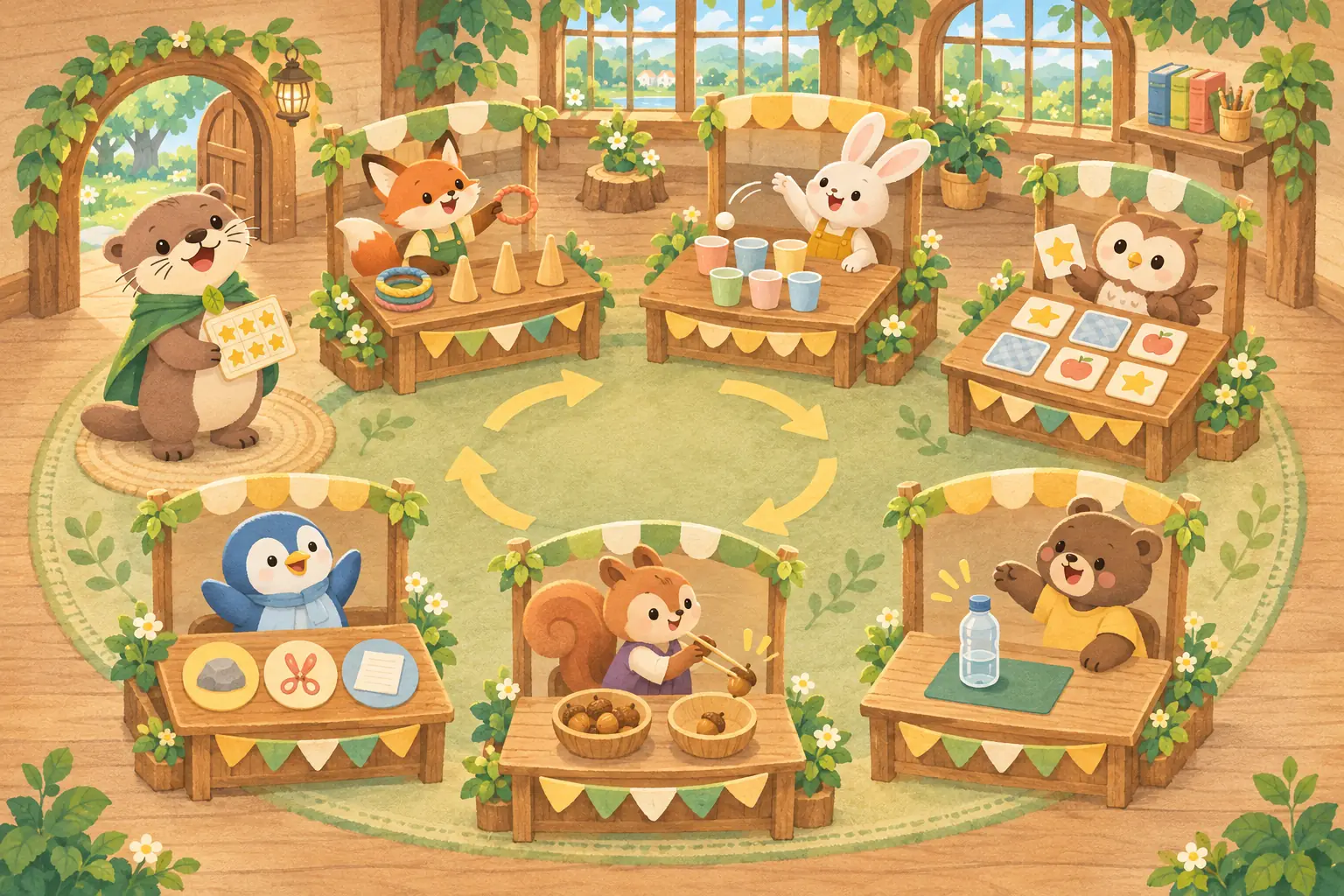
Have your Restoration Crew push two desks together at six spots along the outer walls, leaving the center carpet and doorways completely clear, and draw a clockwise arrow on the board (`"Max 3 players waiting at any booth—if full, hop to the next open booth!"`):
| Carnival Booth | Zero-Cost Classroom Supplies | 30-Second Stamp Challenge | K-2 vs. Grades 3-6 Tweak |
|---|---|---|---|
| 1. Paper-Ring Bottle Toss | 5 twisted scrap-paper rings taped round + 3 weighted water bottles | Stand behind tape line and ring 2 of 5 tosses | K-2 stand 3 feet out; 3-6 score distance tiers |
| 2. Cup-Bounce Sharpshooter | 3 ping-pong balls + 6 paper cups weighted with erasers | Bounce ball once on desk into any cup (1 of 5 lands) | K-2 tight triangle cluster; 3-6 single straight line |
| 3. Campus Memory Flip | 12 index cards with 6 student-drawn school icon pairs | Lay `3 × 4` face down; match 3 pairs within 40 seconds | K-2 use 8 cards (`2 × 4`); 3-6 use 16 vocabulary pairs |
| 4. Upright Bottle Flip | Two 500 mL plastic bottles filled one-third with water (caps tight!) | Flip bottle once so it lands upright on desk (1 in 5 tries) | K-2 use wide-base square bottles; 3-6 try dual-hand flip |
| 5. Pom-Pom Tongs / Chopstick Dash | 2 bowls + 10 paper balls or erasers + plastic tongs or chopsticks | Transfer 8 items from left bowl to right in 30 seconds | K-2 use a plastic spoon; 3-6 use non-dominant hand |
| 6. RPS Stepping-Stone Gauntlet | 5 taped construction-paper floor pads spaced half a step apart | Win Rock-Paper-Scissors vs. booth host to advance 3 pads | Zero reading barrier; 2 losses in a row earn a free mercy hop |
Set the carnival goal at "Collect any 4 of 6 stamps to complete your passport" with zero candy leaderboard—removing cutthroat rushing while keeping every booth buzzing.
5 Inclusive Whole-Group Games Where Shy Students Thrive
Between booths and snack time, anchor the room with one or two whole-class classroom party games. Skip Musical Chairs or elimination "hot potato" games that leave twenty-two eliminated kids bored on the sidelines (or diving headfirst into desk legs!), and run games where all thirty students play simultaneously from their seats:
- Class Memory Bingo: Hand out blank `3 × 3` or `4 × 4` grids and brainstorm twenty real moments from your semester onto the whiteboard (`Field trip to the science museum`, `Class jump-rope record`, `Bean sprout grew 6 inches`, `Fire drill in the drizzle`, `Taco Tuesday lunch`, `Finished our chapter-book read-aloud`). Students fill their own squares in any order and cheer as student callers draw slips.
- Row-Team Charades Hot-Seat: Keep students in their existing five or six desk rows; one guesser per row sits facing away from the board while seated row-mates silently act out three prompts in ninety seconds. Pull instant kid-tested prompts straight from our 600 classroom charades words and Pictionary bank.
- Mystery Classmate Highlight: The day before the party, each student writes three positive true clues about themselves on an index card (`"1. I help organize the classroom library; 2. I love drawing comics; 3. I mastered my 7s multiplication facts this fall"`). Emcees read one card aloud while table pods write their guess on mini-whiteboards—giving quiet students warm recognition without solo public speaking.
- Silent Over-the-Shoulder Cup Pass: Place a stack of five paper cups on the front desk of each row. On `"Go"`, with zero talking allowed, Row Seat 1 lifts the top cup and passes it backward one desk at a time until all five cups re-stack on the back desk and travel all the way back to the front—instantly dropping room volume to a hush.
- Four-Corner Semester Favorites: Label the room's four corners `A`, `B`, `C`, and `D`, then call low-stakes prompts (`"My favorite memory this term was: A) Field Day, B) Science labs, C) Art projects, or D) Read-aloud time"`). Students walk calmly to their corner and share why with a nearby classmate for thirty seconds—zero spotlight anxiety required.
Allergy-Safe Snack Guidelines and Ready-to-Send Family Note
Snack time requires clear advance guardrails around severe food allergies, choking hazards, and family equity. Pediatric school allergy guidelines emphasize verifying ingredient labels in advance, preventing cross-contact from shared reach-in bowls, and keeping non-food celebration focus central (Sicherer et al., 2020). Aligning your family note with nutrition-smart individual portions (or simple non-food celebrations if your building has a strict zero-food policy) keeps everyone safe:
- Verify All Nine Major Allergens One Week Early: Cross-check your school nurse's health roster with the family return slip below (peanuts, tree nuts, milk, eggs, wheat, soy, sesame, fish/shellfish, plus halal, kosher, vegetarian, or celiac needs) before any shared item enters the room.
- Keep Eating 100% Seated & Choking-Safe: Skip whole nuts, hard candies, mini gel cups, whole grapes with seeds, or speed-eating contests; students only open wrappers once seated calmly at desks.
- Individual Portions Over Open Communal Bags: Ask families to send just 1–2 store-labeled single-serve snacks for their own child (plus a water bottle), or have masked Snack Crew helpers use clean tongs if your room parent provides pre-sliced fruit or pizza.
- Zero Expensive Goodie-Bag Pressure: Explicitly ask families not to send pricey gift bags or sugary sodas for all thirty students so every household participates comfortably.
Dear Families,

To celebrate our hard work this term, our class will hold a student-planned End-of-Term Celebration on __________ (Date) during __________ (Time). Students are working in four classroom committees to organize a 3-minute opt-in talent share, zero-cost desk carnival games, and semester appreciation cards!

To keep snack time safe, healthy, and stress-free for every family, please note:
1. Simple Personal Portion Only: Please send just 1–2 store-packaged, ingredient-labeled snacks and a water bottle for your own child to enjoy—there is zero need to buy treats or goodie bags for the whole class.
2. Classroom Safety Guidelines: Please avoid sodas, glass bottles, hard candies, mini gel cups, and whole peanuts/tree nuts (check below if our room has specific allergen restrictions).
3. Seated, No-Trading Rule: Students will wash hands and enjoy their own snack at their desks without trading food. Please return the bottom slip by __________ so we can keep every student safe!

Warmly,
____________________

--------------------------------------------------
CLASS CELEBRATION ALLERGY & DIETARY SLIP (Student Name: ______________)
[ ] My child has NO food allergies or special dietary restrictions.
[ ] Please note my child's food allergy or dietary restriction (e.g., peanut, tree nut, dairy, egg, gluten, sesame, vegetarian/halal):
    __________________________________________________
Parent / Guardian Signature: __________________The Final 15 Minutes: Appreciation Shout-Out Cards and Flash Cleanup
The difference between a class party you dread repeating and one you love hosting every semester lives in the final fifteen minutes: a ten-minute, four-step Restoration Relay followed by five peaceful minutes exchanging peer shout-out cards. When your cleanup chime rings at Minute 75, project or sketch this four-stage flow so every pair of hands knows its exact job:
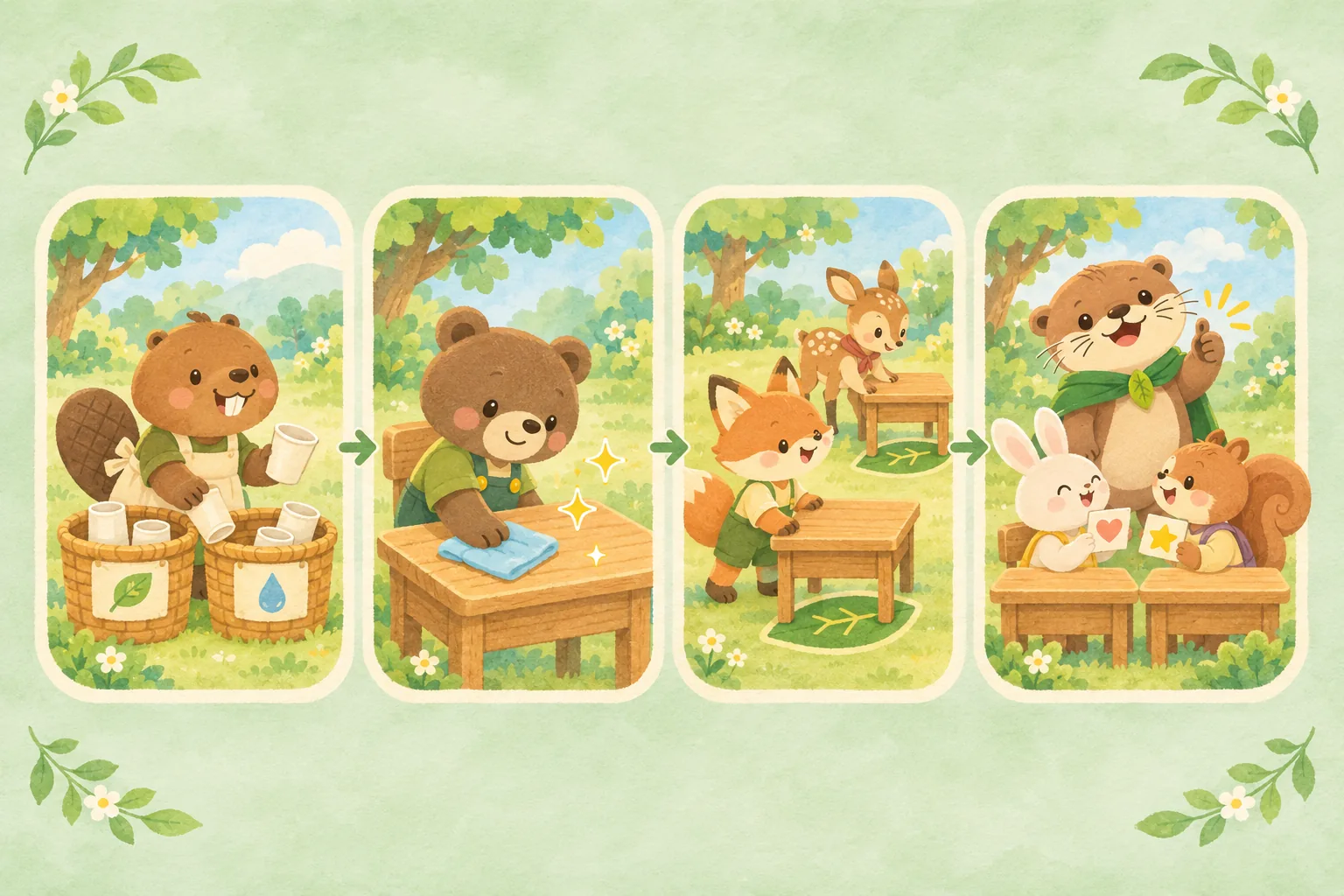
- Stage 1 (Minutes 1–3) — Walking Bin Sort: Restoration Crew members walk two lined tubs (`Paper/Cups` and `Wrappers/Trash`) down each aisle while students flatten empty cups and check inside desk cubbies so zero half-full drinks hit trash bags.
- Stage 2 (Minutes 4–5) — Damp Wipe, Then Dry Wipe: Snack Crew passes damp paper towels to every student to wipe down their own desktop and chair seat.
- Stage 3 (Minutes 6–8) — Lift-Don't-Drag Floor Tape Reset: Working in pairs, students lift (never screech-drag!) perimeter desks back onto the painter's-tape marks placed before the party, then pick up three scraps within arm's reach.
- Stage 4 (Minutes 9–15) — Semester Shout-Out & Time-Capsule Cards: Seated in a sparkling-clean room, students draw a classmate's name (or write to a helpful tablemate and specials teacher) using the specific sentence frames below, ending the party on a grounded, heartfelt note. If students also want to thank art, music, PE, or library teachers before break, pair this step with the card templates in our thank you card for teacher lesson guide.
OPTION A: GRADES K-2 FILL-IN SHOUT-OUT CARD (Pick 1 Frame)
1. Thank you, ____________, for helping me when ________________________ this term!
2. One awesome thing ____________ is great at is ________________________!
3. My favorite memory with ____________ this semester was ________________________!

OPTION B: GRADES 3-6 SPECIFIC APPRECIATION & TIME CAPSULE
1. Peer Shout-Out: I still remember during ________________ (science lab / recess / group project) when you ________________________. It made our class feel ________________.
2. Teamwork Note: Whenever we worked at the same table, I appreciated how you always ________________________.
3. Note to Future Me (End-of-Term Time Capsule): One hard thing I figured out this semester was ________________________, and next term I want to try ________________________.
FAQ
How do you structure an 80-minute class party so kids don't get wild or leave a huge mess?
Follow an 'Active First, Snack Seated, Restore Last' arc: 10 minutes for a seated icebreaker, 30 minutes for optional 3-minute student talent acts and whole-class bingo, 25 minutes for two-shift desk carnival booths, 10 minutes for seated allergy-checked snacks, and a non-negotiable final 15 minutes for four-step cleanup and appreciation cards.
How can 3rd, 4th, and 5th graders plan their own end-of-term class party?
One week out during Morning Meeting or class council, set three firm teacher guardrails (total minutes, zero money or store-bought prizes, walking feet only) and split all 28-30 students into four committees: Emcee & Timer Crew, Carnival Booth Crew, Snack & Hygiene Crew, and Restoration Crew. Giving every child a named job dramatically improves self-regulation.
What zero-cost classroom party games work as carnival booths in a small room?
Push pairs of student desks against the side and back walls to build six supply-closet booths: Scrap-Paper Ring Toss over water bottles, Ping-Pong Cup Bounce, Hand-Drawn Memory Match, Water-Bottle Flip, Chopstick or Spoon Pom-Pom Relay, and Rock-Paper-Scissors Stepping Stones—keeping a clockwise walkway open in the middle.
How do I handle food allergies and families' different budgets fairly at a class party?
Send a family note and allergy return slip one week ahead checking peanut, tree nut, dairy, egg, soy, wheat, sesame, and dietary restrictions. Ask each child to bring only 1-2 individually labeled, store-packaged personal snacks (or washed fruit) rather than whole-class goodie bags, eliminating both cross-contact guesswork and financial pressure.
How do I include shy or introverted students who hate elimination party games?
Keep talent spots 100% opt-in and offer valued behind-the-scenes roles like Timekeeper, Booth Stamp Host, or DJ Chime Ringer. For whole-group play, swap Musical Chairs or elimination dodge games for Class Memory Bingo, Mystery Classmate Clues on mini-whiteboards, and Four-Corner Favorites where nobody ever sits out.
Sources
- An Educational Psychology Success Story: Social Interdependence Theory and Cooperative LearningEducational Researcher2009
- Self-determination theory and the facilitation of intrinsic motivation, social development, and well-beingAmerican Psychologist2000
- Management of food allergy in the school settingJournal of Food Allergy2020
- Classroom Management — Coalition for Psychology in Schools and EducationAmerican Psychological Association2023