 ClassMori
Teaching articles
28 Classroom Vocabulary Games for Elementary ELA & EAL (Zero Prep)
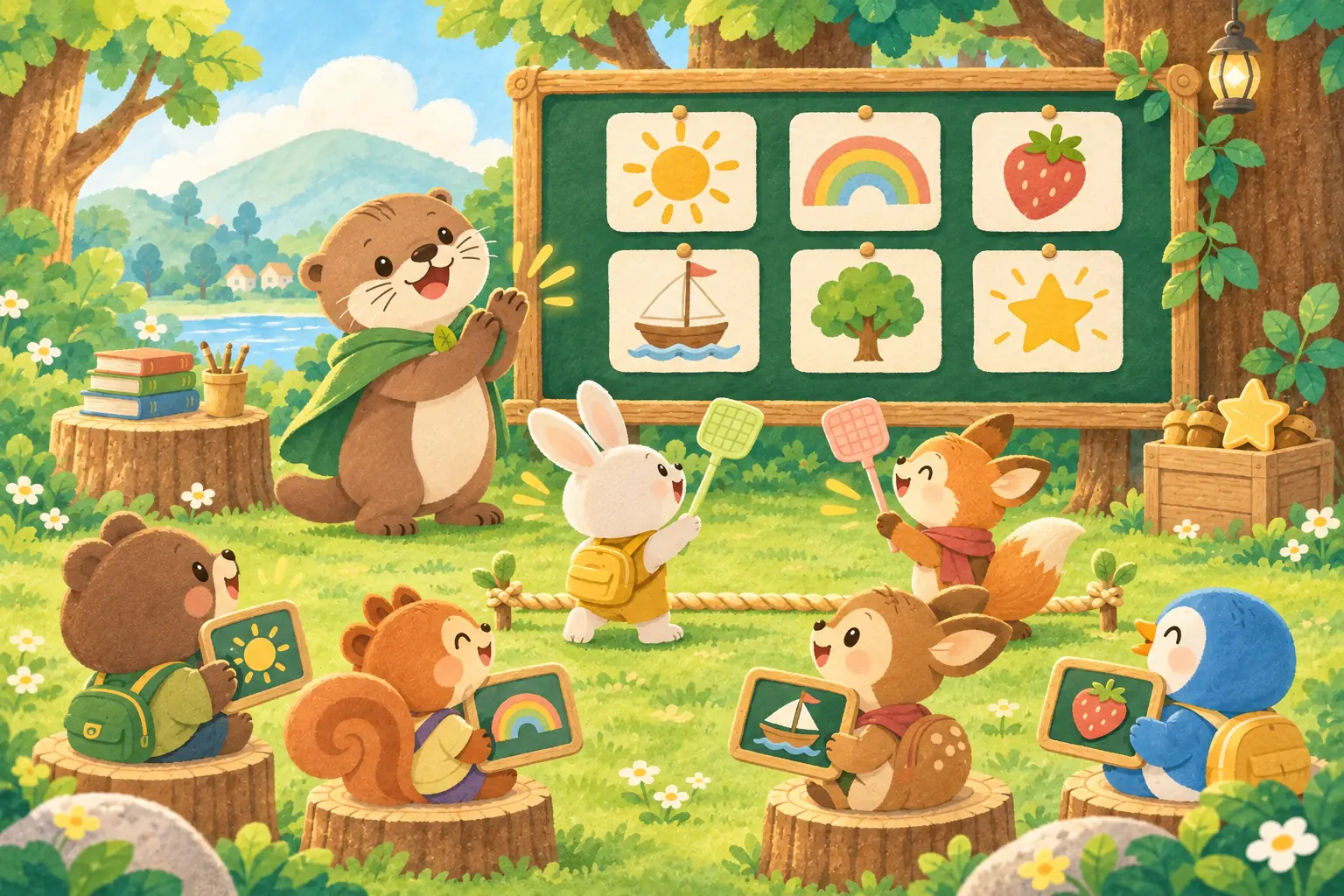
The quickest test of great classroom vocabulary games is counting how many students are actively retrieving a word during any sixty-second slice—not watching two confident kids duel with flyswatters at the board while twenty-eight classmates daydream. Whether you teach elementary ELA Tier-2 vocabulary, foundational word study, or multilingual EAL/ESL groups, pairing your existing picture cards and clear plastic sheet protectors with simultaneous response routines gets every child listening, speaking, and spelling in under two minutes of prep.
Organized along the natural acquisition arc—receptive listening -> choral & partner speaking -> syllable-aware spelling -> four-player tabletop review—all 28 games below include mixed-proficiency scaffolds, 16 crisp transition cues, a 40-minute block template, and a 72-word elementary starter bank.
3 Rules for High-Participation Classroom Vocabulary Games
Vocabulary researcher Paul Nation (2013) emphasizes balancing meaning-focused input, meaning-focused output, language-form study, and fluency across varied encounters—while cognitive psychology confirms that active retrieval practice cements long-term retention dramatically better than passive re-reading (Roediger & Karpicke, 2006).
In real elementary classrooms where one table includes newcomer multilingual learners and another includes voracious chapter-book readers, three simple design rules keep everyone in the game:
- Turn Every Front-of-Room Turn Into a 100% Audience Job: Even when two runners hop along floor cards up front, seated teammates must chant each word in unison for the hop to count—or write answers on sheet-protector dry-erase sleeves and flip on `"3, 2, 1!"`
- Offer a Three-Tier Challenge Ladder on Every Card: Drawing on Laufer and Hulstijn's (2001) task-induced involvement framework, let students choose or rotate across three ways to earn points on the same target word so emerging and advanced learners both contribute meaningfully.
- Build In a 3-Second Partner Whisper First: Saying `"Whisper your idea to your shoulder partner for three seconds"` before calling `"Fingers up!"` gives hesitant learners a low-anxiety rehearsal every single round.
| Student Readiness Tier | Receptive Task (1 Point) | Oral Output Task (2 Points) | Spelling & Context Challenge (3 Points) |
|---|---|---|---|
| Emerging / Newcomer EAL | Listen to the word and hold up `1–4` fingers matching the numbered card | Echo or choral-say the target word clearly with tablemates | Identify the initial consonant/digraph sound and trace the word |
| Developing / On-Grade | Match a spoken definition or synonym clue to the right word card | Name the word + article or part of speech within 3 seconds | Fill in missing vowel teams or syllable chunks on a dry-erase sleeve |
| Expanding / Enrichment | Identify which target word completes a two-sentence mystery context | Use the word to ask a partner an original comprehension question | Spell the full word from memory and compose a vivid context sentence |
Keep game pacing crisp with predictable routine cues taped beside your whiteboard:
1. Eyes on me, hands on your knees—wait for "Go!" before moving.
2. Show me silently on your chest: one, two, three, or four fingers?
3. Whisper the word to your shoulder partner in three seconds.
4. Marker caps click shut! Dry-erase sleeves up in 3, 2, 1!
5. Level-Two voices only—clear partner speaking, zero shouting.
6. Whole team says the word together, or the hop freezes!
7. Rock, paper, scissors—one quick shoot! Winner keeps hopping.
8. Outer circle, step one spot clockwise when the chime rings.
9. Pass the marker after every single letter—coach with words, don't grab!
10. Check your partner's vowel team kindly before holding boards high.
11. Freeze like woodland statues in 3, 2, 1!
12. Hands on your head if the definition matches; cross arms if it's a trick!
13. Final lightning round—double points for a complete context sentence!
14. Stack word cards neat and flat on the top-right corner of your desk.
15. Wipe sleeves clean in five counts: 5, 4, 3, 2, 1, markers parked.
16. One slow breath in, breathe out, and open vocabulary notebooks to today's page.
7 Zero-Prep Listening & Picture-Card Games for Brand-New Words
During the first ten minutes after introducing six to eight new words, students need high-volume, low-stress sound-to-meaning mapping before anyone is put on the spot to spell:
| Game Name | Grade Range | Prep Time | How All 30 Students Respond Simultaneously |
|---|---|---|---|
| 1. Card-Hop RPS Duel | Grades K–6 | 1 min | Seated teammates must chant every card aloud as their runner hops |
| 2. True-or-False Echo Clap | Grades K–4 | 0 min | Echo + double clap if accurate; instant crossed-arm freeze if mismatched |
| 3. Two-Card Missing Swap | Grades K–5 | 0 min | 3-second partner whisper, then silent finger numbers + choral reveal |
| 4. Four-Pose Context Code | Grades K–4 | 1 min | Four tricky words map to four desk poses performed on spoken sentences |
| 5. Silent Lip-Reading Detective | Grades 1–6 | 0 min | Watch articulation mouth shapes (`b/v`, `th/s`), confirm with partner, show fingers |
| 6. Lightning-Card Duck | Grades 1–5 | 0 min | Rapid choral card flip; touch desktop silently whenever the starred card appears |
| 7. Folded 4-Square Riddle Bingo | Grades 2–6 | 2 min | Fold scrap paper into 4 boxes, sketch/write 4 words, fold corners on riddle clues |
1. Card-Hop Rock-Paper-Scissors Duel
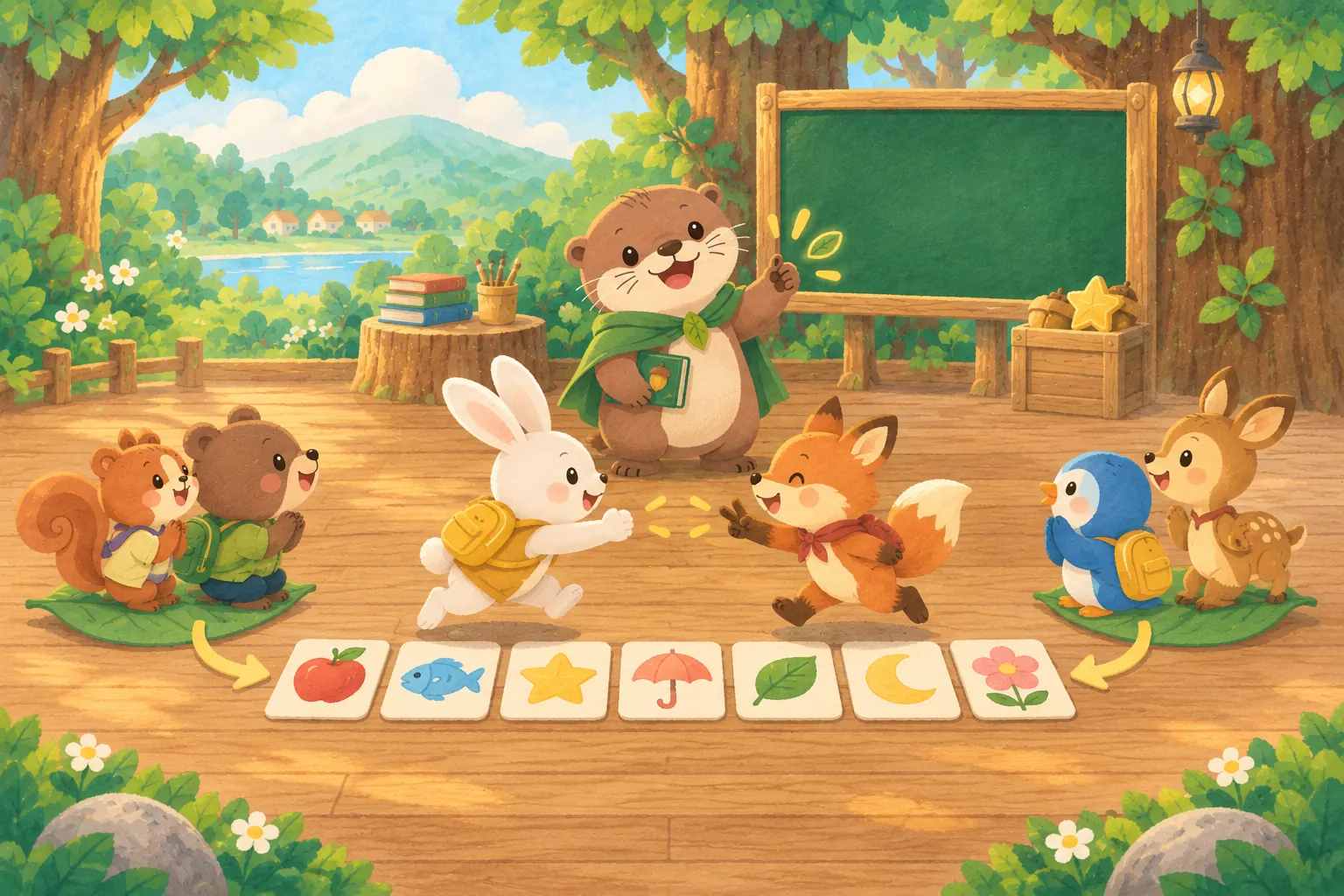
Tape `7` large word or picture cards in a straight line across the front floor (painter's tape keeps corners flat) and split the room into Left Team and Right Team. Runner #1 from each side starts at opposite ends on `"Go!"`—on every step, both the runner and their entire seated team must call out that card's word clearly before advancing. Where the two runners meet, they play one instant shoot of Rock-Paper-Scissors: the winner keeps hopping toward the rival end zone while the other hustles to the back of their line as Runner #2 launches immediately from Card 1.
2. True-or-False Echo Clap
Line `6–8` vocabulary cards across your whiteboard. Point to one card and say a word or context sentence (`"The desert is arid and dry"`): if your speech matches the card, the class echoes the phrase and claps twice; if you point to `arid` while saying `"drenched with rain,"` the class must clamp lips shut and cross arms like statues. If even two students accidentally clap on a trick, the Teacher gets `+1`; when the class holds strong, Students get `+1`!
3. Two-Card Missing & Flipped Swap
Upgrade classic *What's Missing?* for Grades 2–5: number six board cards `1–6`, chant them once, and have everyone close eyes for three seconds while you remove one card and flip another upside down (or swap two positions). On `"Open!"` give three seconds for shoulder partners to whisper before everyone flashes the changed card numbers on their fingers.
4. Four-Pose Context Code
Skip chaotic four-corner sprinting and anchor four easily confused words to four seated moves on the board (`1 = hands on head`, `2 = touch shoulders`, `3 = stand tall`, `4 = palms flat on desk`). Speak natural sentences using the words in context (`"The cautious squirrel paused before crossing"`); students perform the matching pose the instant they catch the target word.
5. Silent Lip-Reading Detective
Ideal for sharpening phonological contrast (`berry / very`, `three / tree`, `ship / sheep`, or multisyllabic stress): mute your voice completely at the front of the room and exaggerate clear mouth and tongue placement for one numbered word on the board. Pairs compare observations and hold up the matching card number before everyone pronounces it aloud together.
6. Lightning-Card Duck
Clip a small star magnet to the back of `1` card in an `8-card` stack and show the class which word is today's "Lightning Word." Flip rapidly through the deck as the class reads every card at a brisk clip—until the Lightning Word appears, when everyone must go completely silent and touch both palms to their desk edge. To extend into full-body acting clues, pull action verbs or idioms straight from our 600 classroom charades words bank.
7. Folded 4-Square Riddle Bingo
Zero photocopies required: students fold a quarter-sheet of scrap paper twice to create four boxes and write (or quick-sketch) any `4` words from today's `8-word` bank. Instead of calling words directly, read kid-friendly definitions, synonyms, or cloze sentences (`"Something fragile breaks easily if dropped"`); students fold down matching corners until the first four-corner winner reads all four words back.
7 Choral Rhythm & Partner Speaking Games for Reluctant Speakers
Many elementary students understand new vocabulary receptively yet freeze when called on solo in front of twenty-nine peers. Wrapping oral practice inside choral beats or fifteen simultaneous partner pairs creates a warm acoustic shelter where shy speakers and emerging EAL learners speak up ten times per lesson.
8. Inside-Outside Speaking Circle
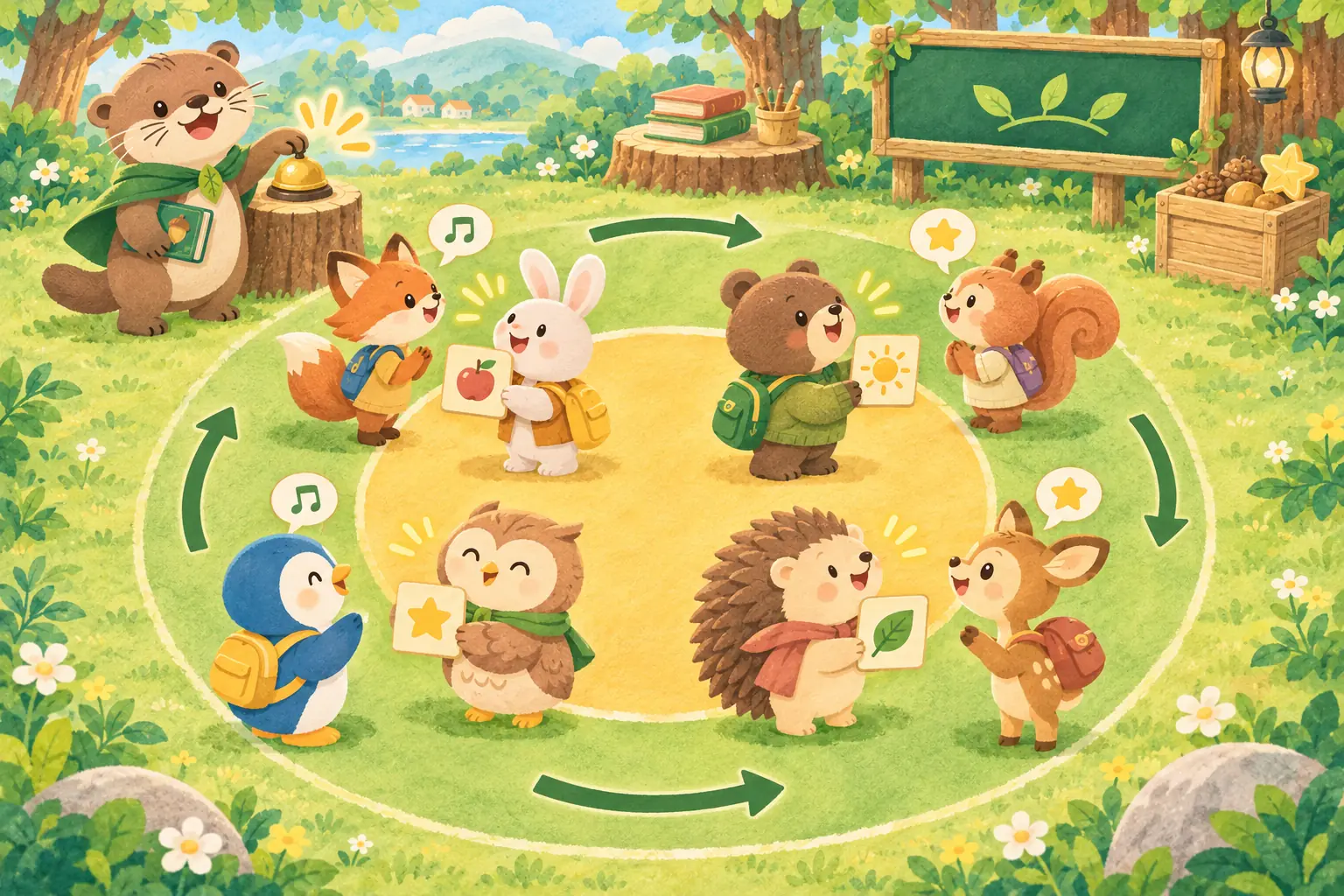
Hand every student one vocabulary card (word on front, sketch or sentence starter on back) and form two concentric circles of fifteen students: the inner ring faces out, and the outer ring faces in so everyone has an immediate partner. Give `30 seconds` for Partner A and Partner B to quiz or interview each other using the card's word, then tap your desk chime once—inner circle stays planted while the outer circle steps one spot clockwise for a brand-new partner, logging eight rich repetitions in six minutes!
9. Volume-Thermometer Treasure Chant
Send one volunteer detective just outside the open doorway for ten seconds while you lay a vocabulary card flat on one student's desk. As the detective walks back in searching, the entire class repeats the target word (or sentence frame) on a loop—whisper-soft when the detective is far away and rising to a confident Level-2 choral read (strictly zero screaming!) right beside the desk.
10. Pat-Pat-Clap-Clap Rhythm Chain
Anchor multisyllabic pronunciation to a steady `pat thighs twice, clap hands twice` four-beat pulse. On the two thigh pats, call a card number (`"Card Six!"`); on the two claps, the whole class (or a called row) chants the word cleanly on beat (`"Ha-bi-tat!"` or `"Ma-gnif-i-cent!"`), smoothing out hesitant syllables effortlessly.
11. Forehead Mystery Trio (3 Clues, Zero Charades)
Seat three volunteers facing the class and stick one word card above each student's head on the whiteboard. Rather than acting, the audience gives verbal clues only: in Grades K–2, table pods offer synonym or category clues (`"It is a habitat with tall trees and heavy rain"`); in Grades 3–6, hot-seat players ask up to three yes/no classification questions (`"Is it an adjective? Would a scientist use it?"`) before guessing.
12. Hand-Up Quiz-Quiz-Trade
Each student starts with one vocabulary slip containing a word and sample sentence on the back. Students raise one hand to find an open partner, give a gentle tap-five, take turns quizzing each other's card (`"Read the word + use it in a sentence"`), trade cards, and raise a hand to pair with someone new. During the first month of school, blend this structure with prompts from our getting to know you games and icebreakers so new classmates learn names and academic terms together.
13. Six-Character Voice Dice
Repeating tough academic words six times feels hilarious instead of repetitive when a foam die picks the voice persona written on the board: `1 = Friendly Robot`, `2 = Sleepy Giant Yawn`, `3 = Secret Agent Whisper`, `4 = Opera Singer`, `5 = Sports Announcer`, `6 = Underwater Bubble Voice`. Roll once and read four target sentences together in character!
14. Partner Sentence Tic-Tac-Toe
Project a `3 × 3` grid of nine unit vocabulary words while partners sketch a quick hash grid on scratch paper. Before claiming any square with an `X` or `O`, the player must speak a complete, accurate sentence using that square's word—verified by their partner before marking.
7 Dry-Erase Sleeve & Syllable-Chunking Spelling Games
Once upper-elementary expectations shift toward accurate spelling and morphology, rote letter-by-letter memorization (`e-n-v-i-r-o-n-m-e-n-t`) frustrates struggling readers. Anchor every spelling game in phoneme-grapheme mapping and syllable chunks—and for early-grade sound-box foundations that transfer straight into multisyllabic decoding, pair these games with our phonics blending and sound-box guide.
| Spelling Game | Word-Study Focus | Grade Band | Built-In Confidence Scaffold |
|---|---|---|---|
| 15. Sheet-Protector Showdown | Phoneme-to-grapheme full spelling | Grades 2–6 | Clap syllables first + post tricky vowel-team bank on board |
| 16. One-Letter-Per-Desk Relay | Orthographic sequence & peer check | Grades 2–6 | Each seat writes 1 letter or fixes 1 prior letter—no solo takeover |
| 17. Missing-Vowel Decoder | Vowel teams, r-controlled, schwa | Grades 2–6 | Consonant frame pre-given so focus stays on vowel patterns |
| 18. Syllable-Chunk Train | Multisyllabic prefixes, roots, suffixes | Grades 3–6 | Scrambles whole pronounceable syllables, never random letters |
| 19. Build-a-Snowman Rescue | High-frequency vowel-first deduction | Grades 2–6 | Positive cooperative build replaces hangman; zero elimination |
| 20. One-Sound Word Ladder | Phoneme manipulation & digraphs | Grades 1–5 | Changes exactly 1 sound/spelling per rung with meaning clues |
| 21. Hands-Behind Walking Dictation | Orthographic memory + oral spelling | Grades 3–6 | Runner may never touch the pencil; roles swap halfway |
15. Sheet-Protector Dry-Erase Showdown
Slip a sheet of cardstock (blank on one side, primary handwriting lines on the other) inside thirty clear plastic binder sleeves for instant zero-budget whiteboards. Pronounce the word, clap its syllables together (`in-ves-ti-gate` = 4 claps), give ten seconds to write, and call `"Sleeves up!"`—letting you spot the exact vowel pattern half the class missed and reteach it in twenty seconds.
16. One-Letter-Per-Desk Row Relay
Place one blank index strip on the front desk of each six-student row and announce an eight-letter target word (`mountain` or `discover`). Seat 1 writes only Letter 1 (`m`) and passes backward; each subsequent teammate may either add the next single letter OR neatly fix one earlier letter. Because nobody can write two letters in a row, stronger spellers naturally whisper phonics hints rather than grabbing the pencil.
17. Missing-Vowel Team Decoder
Ninety percent of elementary spelling slips happen on vowel teams and r-controlled vowels, not outer consonants. Write six consonant skeletons on the board (`w _ _ t h _ r`, `c _ _ t _ _ s`, `j _ _ r n _ y`) beside a small Vowel Bank (`ea, er, au, iou, ou, ey`) and give partners ninety seconds to reconstruct all six words and air-trace the vowel chunks.
18. Syllable-Chunk Train Cars
Traditional letter scrambles (`n-o-c-v-e-a-r-s-t-i-o-n`) break phonological processing. Scramble intact syllable cars inside drawn train carriages instead (`sa` / `con` / `tion` / `ver` or `bi` / `ha` / `tat`), asking pairs to tap out the spoken syllables and hook the train cars in order.
19. Cooperative Build-a-Snowman
Draw blank letter dashes for a mystery unit word alongside a dotted six-part snowman (or six-petal flower). Rows rotate guessing one letter—coaching students to test vowels (`a, e, i, o, u`) and common digraphs (`sh, ch, th, st`) first—working as one united class to solve the word before the sixth snowflake melts!
20. One-Sound Word Ladder
Start at the bottom rung of the whiteboard with a familiar base word (`chat`) and climb five rungs by changing one phoneme (sound) per clue: `"Change one sound to mean part of your face below your mouth"` -> `chin`; `"Make it thin"` -> `thin`; `"Something arose on a stem"` -> `thorn` (or `shin -> ship -> shop -> chop`).
21. Hands-Behind-Back Walking Dictation
Tape four identical copies of six short vocabulary sentences at eye level on the classroom walls. In seated pairs, the Messenger walks briskly (running sends you back to your chair!) to read Sentence 1, walks back with hands clasped behind their back, and dictates + spells aloud for the Scribe—swapping roles after Sentence 3.
7 Four-Student Tabletop Cooperative Vocabulary Games
During unit review or literacy centers, swiveling pairs into four-person pods shrinks the stage to a friendly tabletop where every child speaks twenty times in ten minutes:
22. Mini-Grid Eraser Point
Print `12–16` words or icons on a single sheet placed flat at table center; each of the four players holds their own pink block eraser (preventing fingernail collisions from hand-slapping!). Read a synonym, antonym, or cloze clue aloud; the first student to rest their eraser gently on the right box earns `+1` and calls the next clue for their pod.
23. Four-Word Cycle Snap
Using student mini word cards shuffled face down, pods agree on a four-word spoken loop (`"predict, observe, measure, compare"`). Rotating clockwise, players flip one card while speaking the next word in the loop; whenever the spoken word matches the flipped card, players stack open palms on a blank spot of the desk!
24. Friendly Taboo with Sentence Starters
Write three supportive frames on the board (`"It is a noun/verb/adjective..."`, `"You notice it when..."`, `"An example in our story was..."`). On their turn, a student draws a word slip (`reluctant` or `shelter`) and describes it in two sentences without saying the word itself or gesturing—while developing learners lean right on the board frames.
25. One-Marker Category Brainstorm
Hand each pod a 3-column sheet (`Nouns / Verbs / Adjectives`, or `Desert / Ocean / Forest`) and allow strictly one marker per table. Across two minutes, each writer adds one accurate vocabulary word and immediately passes the marker left—nobody skips a turn, and teammates may spell-coach aloud.
26. Memory Match + Bonus Context Star
Lay `6` word cards and `6` matching definition/picture cards face down (`3 × 4`). Every player reads both flipped cards aloud so teammates track locations; landing a match scores `1 pt`, and weaving that word into a natural sentence with pod support earns `+1 Bonus Team Star`.
27. Odd Word Out Detective
Prepare sets of four tiny slips where three slips share the exact same word (`sprint`) and one slip holds a near-neighbor (`stroll`). Each pod member peeks privately at their slip and speaks one single-word clue around the circle (`"fast"`, `"race"`, `"slow"`, `"legs"`) before pointing on three to uncover who drew the odd slip out!
28. Paperclip-Spinner Review Trail
Print a winding 20-space board filled with unit words marked `1`, `2`, or `3` stars, and anchor a metal paperclip under a pencil tip at the center of a `1–3` circle for an instant zero-cost spinner. Landing on `1 star` = read & define, `2 stars` = spell without looking, `3 stars` = ask a tablemate a question using the word.
Plug any combination of these 28 games into a 40-minute block using the pacing template and 72-word core bank below:
00:00–08:00 | Meaning + Sound/Syllable Launch: Introduce 6–8 words (never 20 at once!) with visuals, kid-friendly definitions, and syllable claps.
08:00–16:00 | Receptive Listening Game (Pick 1): True-or-False Echo Clap (#2) or Card-Hop RPS (#1) so every ear maps sound to meaning.
16:00–26:00 | Choral / Partner Speaking Game (Pick 1): Odd-Even Row Turn-Around (#8) or Six-Voice Dice (#13) using complete sentence frames.
26:00–35:00 | Spelling or 4-Player Table Game (Pick 1): Sheet-Protector Showdown (#15), Missing-Vowel Decoder (#17), or Mini-Grid Eraser Point (#22).
35:00–40:00 | Calm Landing & Exit Check: Wipe sleeves, jot 1 favorite word in vocabulary notebooks, and whisper 1 word at the door.
Animals & Habitats (12): mammal, reptile, predator, camouflage, hibernate, migrate, burrow, canopy, nectar, colony, nocturnal, habitat
Weather & Earth Science (12): breeze, downpour, drought, forecast, temperature, evaporate, glacier, volcano, canyon, horizon, humid, blizzard
School & Inquiry Verbs (12): observe, compare, predict, estimate, investigate, summarize, revise, collaborate, persuade, describe, classify, examine
Character Feelings & Traits (12): curious, reluctant, determined, generous, anxious, relieved, grateful, cautious, courageous, patient, thrilled, exhausted
Everyday Actions & Motion (12): sprint, tiptoe, balance, whisper, gather, arrange, repair, sketch, celebrate, vanish, rescue, assemble
Descriptive Tier-2 Adjectives (12): fragile, enormous, ancient, spotless, tangled, hollow, brisk, vivid, peaceful, sturdy, scarce, peculiar
FAQ
How do I run classroom vocabulary games so struggling readers and EAL newcomers don't shut down?
Replace single-answer spotlight turns with a three-tier team menu on every round: Tier 1 students point to the matching picture card or show finger numbers (1 pt), Tier 2 students name the target word aloud (2 pts), and Tier 3 students use the word in a complete context sentence (3 pts)—plus a 3-second partner whisper check before boards go up.
What zero-prep vocabulary games work best in the first 10 minutes after introducing new words?
Right after introducing 6 to 8 words, focus on high-repetition receptive listening before demanding cold spelling: run True-or-False Echo Claps, Two-Card Missing Swap, Silent Lip-Reading Detective, or Card-Hop Rock-Paper-Scissors using just the picture cards already taped to your whiteboard.
What classroom spelling and word-study games engage 4th, 5th, and 6th graders without feeling babyish?
Upper-elementary students love puzzle-style word study: Missing-Vowel Team Decoders, Syllable-Chunk Trains, One-Phoneme Word Ladders, and Walking Dictation Relays. Sliding notebook paper inside clear plastic sheet protectors gives all 30 students instant dry-erase boards for fast, low-pressure retrieval.
How do you manage speaking vocabulary games with 28 to 30 students without volume exploding?
Skip unstructured mingling and use crisp spatial structures like an Inside-Outside Speaking Circle (or Odd-Even Row Turn-Around in tight rooms) where the outer line steps one spot clockwise only when your desk bell chimes, paired with a strict Level-2 conversational voice cap.
How many minutes should vocabulary games take inside a 40-minute ELA or EAL block?
Cap any single game at 6 to 10 minutes so you stop at peak engagement: spend 8 minutes introducing 6–8 words with phonics/morphology chunks, 8 minutes on a receptive listening game, 10 minutes on partner speaking, 9 minutes on dry-erase spelling or 4-person table play, and 5 minutes on a calm exit check.
Sources
- Learning Vocabulary in Another Language (2nd ed.)Cambridge University Press2013
- Test-Enhanced Learning: Taking Memory Tests Improves Long-Term RetentionPsychological Science2006
- Incidental Vocabulary Acquisition in a Second Language: The Construct of Task-Induced InvolvementApplied Linguistics2001
- Teaching Metalinguistic Awareness and Reading Comprehension With RiddlesThe Reading Teacher2008