 ClassMori
Teaching articles
Make Ten Strategy & Teen Subtraction Guide: Ten-Frames & 8 Grade 1 Games
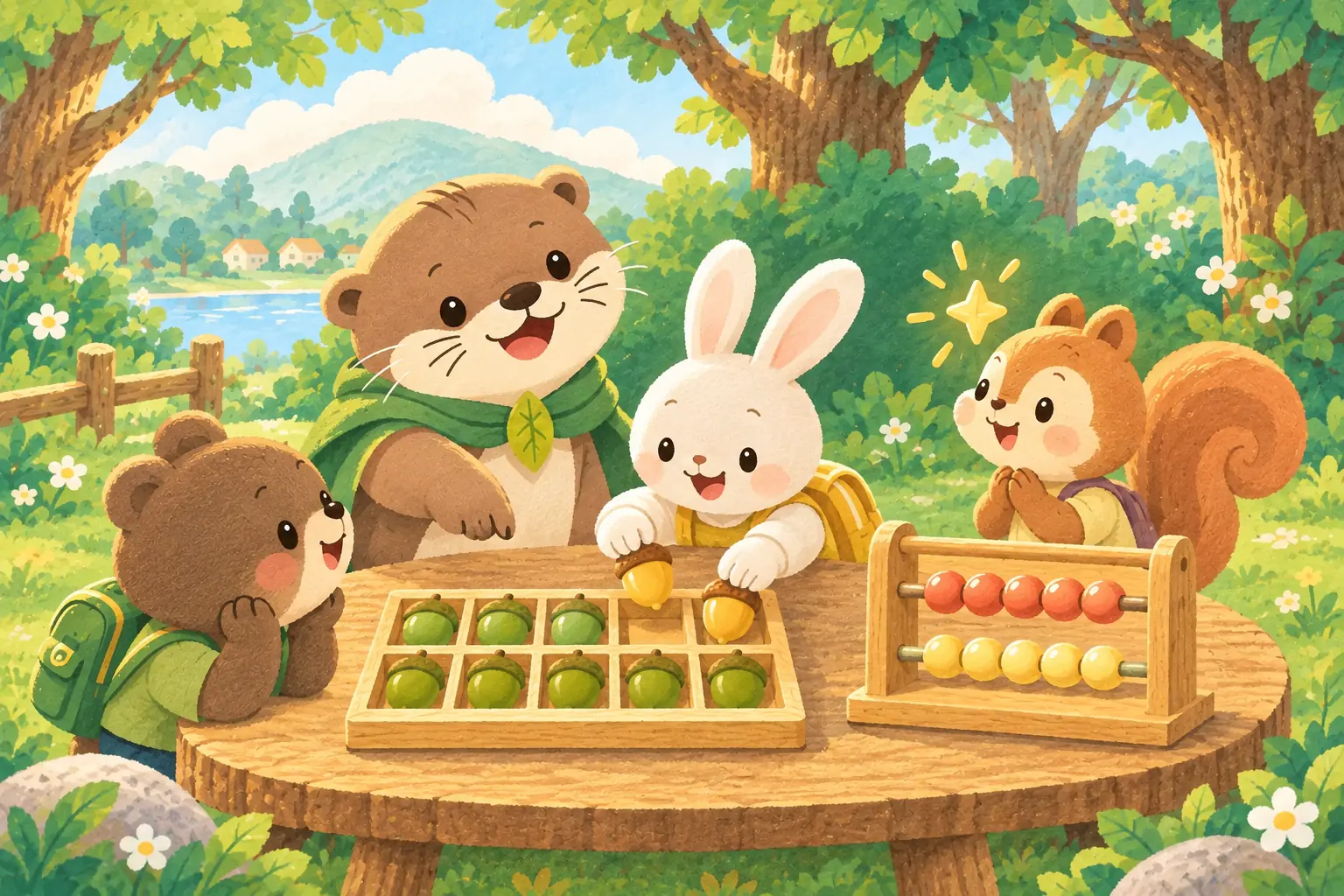
Teaching the make ten strategy gives first graders a visual bridge from one-by-one finger counting to fluent teen addition and Grade 2 place-value regrouping. When a six-year-old physically slides 2 counters into an 8-dot ten-frame to fill a complete box of 10 with 3 left beside it, `10 + 3 = 13` stops being a memorized flashcard fact and becomes an unmistakable base-ten picture.
Aligned with primary operations and base-ten standards (including CCSS `1.OA.C.6` decomposing numbers leading to a ten), this classroom guide brings together a two-minute Friends-of-Ten warm-up, step-by-step ten-frame diagrams for addition and teen subtraction, all 72 single-digit regrouping facts within 20, a ready-to-send family math letter, and 8 five-minute fluency games you can launch tomorrow morning.
Beyond Finger Counting: Why the Make Ten Strategy Builds Place Value
The real reason Grade 1 math curricula invest weeks in making and breaking ten is unitizing ten ones into one ten—not merely getting answers up to 20. Horizontal decomposition in first grade is the concrete dress rehearsal for every vertical "carry a ten" and "ungroup a ten" step students meet in Grade 2 multi-digit arithmetic.
Watch an incoming first grader solve `8 + 5`: most hold 8 in mind, pop up five fingers one at a time, and whisper *"9, 10, 11, 12, 13."* Hand them `13 - 5` and they count backward *"12, 11, 10, 9, 8."* Counting on and counting back work well enough for small single-digit jumps, yet the moment Grade 2 introduces `38 + 25` or `53 - 18`, juggling tens, ones, and finger tracks overloads working memory. Longitudinal research by Hornung et al. (2014) demonstrated that early structural number sense—seeing quantities as flexible parts rather than unit chains—significantly reduces working-memory load and predicts arithmetic fluency across elementary school.
| Strategy Stage | What the Child Actually Does (`8 + 5`) | Typical Bottleneck | Impact on Grade 2 Multi-Digit Regrouping |
|---|---|---|---|
| 1. Count All | Builds 8 on left hand/cubes and 5 on right, then recounts from `1` to `13` | Runs out of ten fingers past 10; slowest path | Cannot see why a `1` in the tens column stands for one bundle of `10` |
| 2. Count On / Back | Holds `8` in mind and raises 5 fingers: *"9, 10, 11, 12, 13"* | Often counts `8` on the first finger and lands off by 1 | Counting backward across tens (`53 - 18`) triggers frequent off-by-one errors |
| 3. Five-Benchmark | Sees `8` as `5 + 3`, combines `5 + 5 = 10`, then adds `3` | Smooth on `6 + 6` or `7 + 5`, clunky on `9 + 4` | Builds subitizing groups of 5 as a helpful bridge |
| 4. Decompose to Make Ten | Spots `8` needs `2` to fill `10`, splits `5` into `2` and `3`, solves `10 + 3 = 13` | Pauses 2–3 seconds early on if Friends-of-Ten aren't automatic | Transfers directly into vertical base-ten regrouping in both addition and subtraction |
Whenever you spot students still tapping fingers under their desks, skip saying *"Stop using your fingers!"* Simply place a double ten-frame or two-row bead rack in front of them so their eyes start trusting "one full box is always ten."
Friends of Ten First: 5 Visual Number-Bond Pairs and a Finger Warm-Up
Nearly every first grader who freezes mid-problem on `8 + 5` isn't stuck on addition—they are stuck wondering *"Wait, what do I split 5 into?"* because partners of 10 aren't automatic yet. Before introducing a single teen addition worksheet, spend three to five mornings running a brisk two-minute Friends-of-Ten warm-up until hearing `8` instantly sparks `2` and hearing `7` instantly sparks `3`.
Classroom intervention research by Salmah et al. (2015) showed that building spatial structuring on a `2x5` ten-frame lets first graders read empty spaces visually—spotting missing complements to ten at a glance rather than memorizing isolated fact tables. Better yet, every student walks into math class carrying a built-in ten-frame: five fingers on the left hand, five on the right, where standing fingers plus tucked fingers always sum to `10`. Just like the brisk 60-second oral sound warm-ups in our Grade 1 phonics blending guide, two minutes of rhythmic daily call-and-response wires automaticity with zero photocopying.
| Friends-of-Ten Pair | Two-Hand Finger Picture (Up vs. Tucked) | `2x5` Ten-Frame Visual Clue | Brisk Call-and-Response Cue |
|---|---|---|---|
| 9 and 1 (`1 & 9`) | 9 fingers tall; only 1 thumb tucked down | Whole frame full except 1 corner box | Teacher: *"Nine needs who?"* Class flashes 1: *"Nine and one make ten!"* |
| 8 and 2 (`2 & 8`) | Full 5 on left + 3 on right; 2 fingers tucked | Top row full, bottom row 3, 2 side-by-side empty boxes | Teacher: *"Eight finds who?"* Class flashes 2: *"Eight and two make ten!"* |
| 7 and 3 (`3 & 7`) | Full 5 on left + 2 on right; 3 fingers tucked | Top row full, bottom row 2, 3 empty boxes in a row | Teacher: *"Seven finds who?"* Class flashes 3: *"Seven and three make ten!"* |
| 6 and 4 (`4 & 6`) | Full 5 on left + 1 thumb; 4 fingers tucked | Top row full, bottom row 1, 4 empty boxes | Teacher: *"Six finds who?"* Class flashes 4: *"Six and four make ten!"* |
| 5 and 5 | Left hand open 5, right hand closed fist 5 | Top row 5 full, bottom row 5 empty (clean symmetry) | Teacher: *"Five finds who?"* Class high-fives air: *"Five and five make ten!"* |
Friends-of-Ten Chant (Anchor Chart)
9 and 1, the day's begun! (9 + 1 = 10, 1 + 9 = 10)
8 and 2, buckle my shoe! (8 + 2 = 10, 2 + 8 = 10)
7 and 3, climb up the tree! (7 + 3 = 10, 3 + 7 = 10)
6 and 4, knock at the door! (6 + 4 = 10, 4 + 6 = 10)
5 and 5, two hands high-five! (5 + 5 = 10)

60-Second "Ten-Box Hands" Warm-Up:
1. Everyone holds ten open fingers chest-high. Teacher calls: "Ten-frames ready!"
2. Teacher flashes 8 fingers (5 left + 3 right) and asks: "Eight acorns in the box—how many empty spaces?"
3. Students glance at their own 2 tucked fingers and call back: "Two empty! 8 and 2 make 10!"
4. Speed Round: Teacher hides hands and calls out just a number—"7!" "4!" "9!"—and students flash the missing partner to 10 in one second.
Teaching Addition Step by Step: Build on the Larger Number to Make Ten
Once your class nails Friends-of-Ten automatically, introduce teen addition through a four-beat mantra: "Spot the bigger number, split the smaller number, fill up ten, add the rest." Protect the Concrete -> Representational -> Abstract progression (`counters -> circling ten on pictures -> number-bond equations`) so no child is asked to draw abstract branches underneath digits before sliding real pieces across a frame.
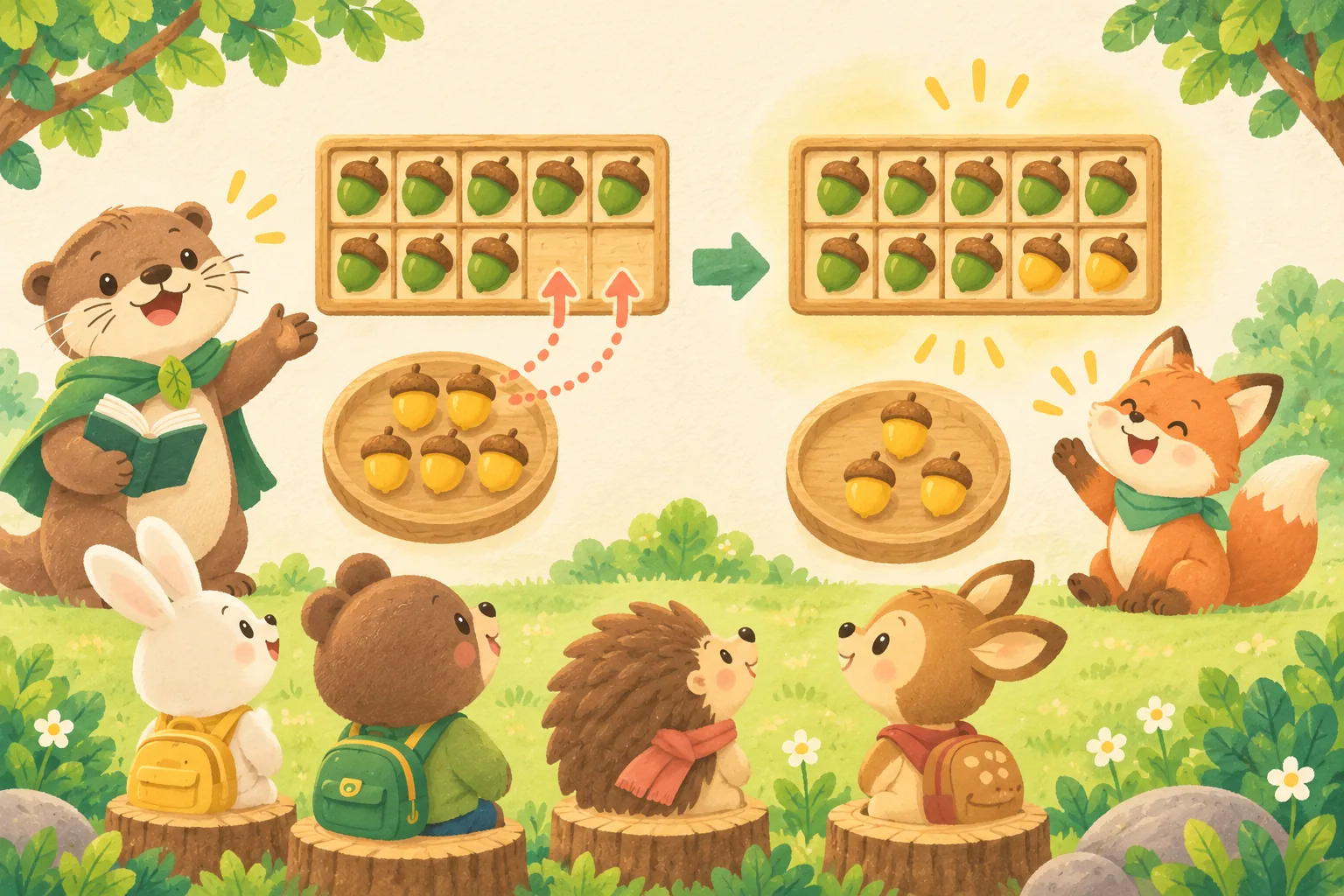
Walk through `8 + 5` together using the acorn-packing story in the diagram above:
- Concrete Slide (Hands-On Counters): Place 8 green counters inside the left ten-frame and 5 yellow counters on a small dish beside it. Ask: *"Which group is closer to filling a box of 10? How many empty spaces are left?"* Students spot 2 empty boxes, physically slide 2 yellow counters into the frame, and read the table at a glance: "One full ten-box plus 3 loose ones—10 plus 3 is 13!"
- Representational Circle (Printed Icons): On workbook pages showing 8 apples and 5 apples, students find the larger group (`8`) and draw a bold loop lassoing `8` together with `2` neighbor apples to label a bundle of `10`, then count the `3` outside the loop.
- Abstract Number Bond (Equation Bridge): Only now write `8 + 5 =` on the board, sketch a small upside-down `V` beneath `5` branching into `2` and `3`, circle `8` and `2` to show `10`, and finish `10 + 3 = 13`.
What About Turnaround Facts Like `4 + 9`? Must We Always Split the Second Number?
Watch out for the classic Grade 1 procedural trap! Students who memorize *"always split the second number"* hit `4 + 9` and painstakingly split `9` into `6` and `3` (`4 + 6 = 10`, `10 + 3 = 13`). Mathematically valid, yes—but subtracting `9 - 6` is far harder for a six-year-old than splitting `4`! That is why our cue says "Spot the bigger number, split the smaller number" regardless of left-or-right order. On `4 + 9`, eyes lock onto `9` first (*"Nine only needs 1 more!"*), split the smaller `4` into `3` and `1`, let `1` hop right into `9` to make `10`, and read `3 + 10 = 13` effortlessly.
| Common Student Snag | Why It Happens | Quick Ten-Frame & Verbal Fix |
|---|---|---|
| Splits `5` in `8 + 5` randomly into `1 & 4` or `2 & 2` | Forgot that splitting serves the goal of filling the larger number to 10 | Point to `8` first: *"Eight is hungry—how many bites until it hits 10?"* Write `2` first, then ask what is left of `5` |
| Splits `9` on `4 + 9` and miscalculates `9 - 6` | Assumed number-bond branches are only allowed under the second addend | Remind the class: *"Either side can split! Nine only has 1 empty space, so let tiny 4 share 1 with 9!"* |
| Makes `10`, then writes `10 + 5 = 15` | Added the original `5` again after 2 counters already moved into the ten-box | Act it out physically: *"Those 2 yellow acorns moved into the ten-house—how many are still sitting on the plate? Just 3!"* |
Level 1: Adding 9 & Turnaround +9 Facts (Split off just 1 to make 10 — 15 facts)
9 + 2 = 11 (split 2 -> 1, 1)   9 + 3 = 12 (split 3 -> 1, 2)   9 + 4 = 13 (split 4 -> 1, 3)   9 + 5 = 14 (split 5 -> 1, 4)
9 + 6 = 15 (split 6 -> 1, 5)   9 + 7 = 16 (split 7 -> 1, 6)   9 + 8 = 17 (split 8 -> 1, 7)   9 + 9 = 18 (split 9 -> 1, 8)
2 + 9 = 11 (split 2 -> 1, 1)   3 + 9 = 12 (split 3 -> 2, 1)   4 + 9 = 13 (split 4 -> 3, 1)   5 + 9 = 14 (split 5 -> 4, 1)
6 + 9 = 15 (split 6 -> 5, 1)   7 + 9 = 16 (split 7 -> 6, 1)   8 + 9 = 17 (split 8 -> 7, 1)

Level 2: Adding 8 & Turnaround +8 Facts (Split off 2 to make 10 — 11 facts)
8 + 3 = 11 (split 3 -> 2, 1)   8 + 4 = 12 (split 4 -> 2, 2)   8 + 5 = 13 (split 5 -> 2, 3)   8 + 6 = 14 (split 6 -> 2, 4)
8 + 7 = 15 (split 7 -> 2, 5)   8 + 8 = 16 (split 8 -> 2, 6)
3 + 8 = 11 (split 3 -> 1, 2)   4 + 8 = 12 (split 4 -> 2, 2)   5 + 8 = 13 (split 5 -> 3, 2)   6 + 8 = 14 (split 6 -> 4, 2)
7 + 8 = 15 (split 7 -> 5, 2)

Level 3: Adding 7, Adding 6 & Near-Doubles (Split off 3 or 4 — 10 facts)
7 + 4 = 11 (split 4 -> 3, 1)   7 + 5 = 12 (split 5 -> 3, 2)   7 + 6 = 13 (split 6 -> 3, 3)   7 + 7 = 14 (split 7 -> 3, 4)
4 + 7 = 11 (split 4 -> 1, 3)   5 + 7 = 12 (split 5 -> 2, 3)   6 + 7 = 13 (split 6 -> 3, 3)
6 + 5 = 11 (split 5 -> 4, 1)   5 + 6 = 11 (split 5 -> 1, 4)   6 + 6 = 12 (split 6 -> 4, 2)
Teen Subtraction Without Confusion: Take-From-Ten vs. Subtract-to-Ten
Cross over into teen subtraction like `13 - 5` and curriculum guides toss around two different names—Take from Ten (decomposing the teen number) and Subtract Down to Ten (decomposing the subtrahend in two hops). Both solve the exact same dilemma: *"I only have 3 loose ones on the plate—how do I take away 5?"*
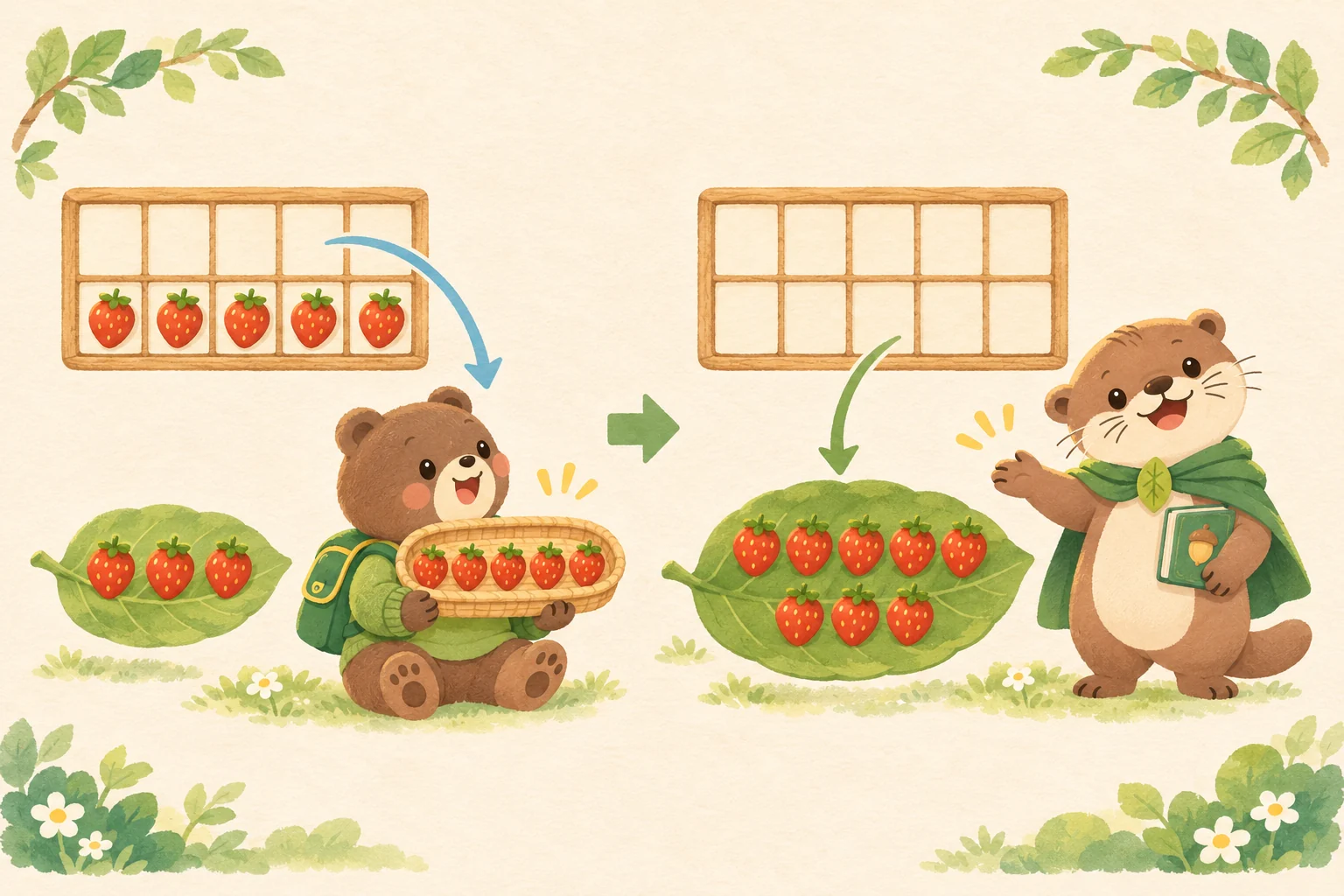
Tell a quick strawberry-carton story for `13 - 5`—one full carton of 10 strawberries on the left plus 3 loose strawberries on a saucer—and your first graders will grasp the difference between the two methods in sixty seconds:
- Take from Ten (Split `13` into `10` and `3`: subtract first, then combine): *"Three loose berries aren't enough to hand over 5—so let's pop open the full carton of 10 and hand the customer 5 berries right out of the box (`10 - 5 = 5`)! Now combine the 5 berries left inside the carton with the 3 untouched berries on the saucer (`5 + 3 = 8`). Eight berries left!"*
- Subtract Down to Ten (Split `5` into `3` and `2`: subtract in two hops): *"The customer wants 5 berries. First hand over all 3 loose berries off the saucer (`13 - 3 = 10`) so an exact carton of 10 sits on the table. We still owe 2 more berries, so take 2 from the carton (`10 - 2 = 8`). Eight berries left!"*
| Feature | Take from Ten (Split the Teen Number) | Subtract Down to Ten (Split What You Subtract) | Classroom Coaching Tip |
|---|---|---|---|
| Equation Path (`13 - 5`) | Split `13` into `10` & `3`; `10 - 5 = 5`, then `5 + 3 = 8` | Split `5` into `3` & `2`; `13 - 3 = 10`, then `10 - 2 = 8` | Model both on ten-frames; let kids choose whichever clicks |
| Sweet-Spot Problems | Lightning-fast when subtracting 8 or 9 (`14 - 9`: `10 - 9 = 1`, `1 + 4 = 5`) | Super intuitive when subtracting small numbers close to the ones digit (`13 - 4`) | Also connect to Think-Addition (`5 + ? = 13`) as a self-check |
| Watch-Out Mistake | After `10 - 5 = 5`, accidentally subtracts `5 - 3 = 2` instead of adding `5 + 3` | Stops at `13 - 3 = 10` and forgets the second hop `- 2` | Cue *"put the leftovers together"* for Take-from-Ten; draw two backward hops on an open number line for Subtract-to-Ten |
| Grade 2 Vertical Link | Mirrors standard vertical regrouping (*ungroup 1 ten into 10 ones*) | Builds flexible backward number-line mental math | If showing both confuses a struggling learner, anchor Take from Ten first |
Dual-Strategy Oral Model: 14 - 8 = 6
- Take-from-Ten Talk: Split 14 into 10 and 4 -> Take 8 from the 10-box (10 - 8 = 2) -> Combine leftovers 2 + 4 = 6!
- Subtract-to-Ten Talk: 14 has 4 ones, so split 8 into 4 and 4 -> Hop back to ten (14 - 4 = 10) -> Hop back 4 more (10 - 4 = 6)!

Set 1: Subtracting 9 (Take-from-Ten Shortcut: 10 - 9 = 1, so ones digit + 1! — 8 facts)
11 - 9 = 2    12 - 9 = 3    13 - 9 = 4    14 - 9 = 5    15 - 9 = 6    16 - 9 = 7    17 - 9 = 8    18 - 9 = 9

Set 2: Subtracting 8 & Subtracting 7 (13 facts)
11 - 8 = 3    12 - 8 = 4    13 - 8 = 5    14 - 8 = 6    15 - 8 = 7    16 - 8 = 8    17 - 8 = 9
11 - 7 = 4    12 - 7 = 5    13 - 7 = 6    14 - 7 = 7    15 - 7 = 8    16 - 7 = 9

Set 3: Subtracting 6, 5, 4, 3 & 2 (15 facts)
11 - 6 = 5    12 - 6 = 6    13 - 6 = 7    14 - 6 = 8    15 - 6 = 9
11 - 5 = 6    12 - 5 = 7    13 - 5 = 8    14 - 5 = 9
11 - 4 = 7    12 - 4 = 8    13 - 4 = 9
11 - 3 = 8    12 - 3 = 9    11 - 2 = 9
Explaining Number Bonds to Families Plus 8 Five-Minute Fluency Games
Every fall when make-ten homework heads home in Friday folders, teachers receive the same heartfelt parent note: *"My child already knows `8 + 5 = 13`—why are they drawing little branches under the numbers? It's confusing them!"* Sending this warm, jargon-free family letter on Day 1 of the unit turns puzzled parents into three-minute dinner-table allies.
Dear First-Grade Families,

This week in math we are exploring addition and subtraction within 20 using "Make Ten" and "Take from Ten" ten-frame strategies. On practice pages, you may notice small number-bond lines drawn beneath equations (for example, splitting the 5 in 8 + 5 into 2 and 3 so 8 + 2 makes 10, plus 3 equals 13).

If your child can already find 8 + 5 on their fingers, you might wonder why we practice splitting numbers! Here are two reassuring things to know:
1. Building Grade 2 Place-Value Roots: Counting fingers works up to 15, but quickly breaks down next year on two-digit problems like 38 + 25 or 53 - 18. Grouping ones into a full unit of 10 builds the exact "regrouping" foundation multi-digit math depends on.
2. Number-Bond Lines Are Temporary Training Wheels: Just like training wheels on a bike, drawing branches helps beginners see how numbers break apart and recombine. Once your child does that mental step smoothly in their head, the written lines fade away naturally!

Easy 2-Minute Home Game (No Worksheets Needed!):
In the car or while setting the table, play "Friends of Ten"—say any number from 1 to 9 (like "7!") and see how fast your child calls back its partner to make 10 ("3!"). Automatic partners of 10 make all of Grade 1 math feel effortless. Thank you for cheering on our young mathematicians!Once concepts click on ten-frames, five minutes of playful partner fluency beats three pages of silent drill worksheets every single time. On sluggish afternoons, these quick rounds double as energizing classroom brain breaks and focus games; better yet, tucking a deck of number cards and Game #1's rules into your emergency sub plans binder gives any guest teacher an instant, high-value 15-minute math station.
- "Go Make Ten" Card Fishing: Partners pull face cards and 10s from a standard deck (`Ace = 1`, keeping `1–9`) and lay 8 cards face-up in a pond. On your turn, match one hand card with one pond card that sums to `10`, announce *"3 plus 7 makes 10!"* aloud, and collect the pair.
- 2-Second Ten-Frame Subitizing Flash: Project or hold up a magnetic ten-frame holding `6` to `9` dots for two seconds, cover it, and ask two rapid questions: *"How many dots did you see? How many empty boxes to make 10?"* Eyes stop counting from one immediately.
- Mirror Hands to Ten: Desk partners face each other. Partner A flashes any finger count from `1` to `9`; Partner B has two seconds to flash the exact complement so their combined fingers equal `10`, then switch roles.
- Peekaboo Bead Screen: Slide 10 beads to the left on a Rekenrek so everyone confirms `10`. Shield the right side with an index card, secretly slide several beads behind the screen leaving `6` visible, and ask: *"How many beads are hiding?"* Connects `6 + ? = 10` and `10 - 6 = 4` simultaneously.
- Roll-and-Slide Acorn Race: Give pairs one laminated ten-frame pre-loaded with `8` counters, a side cup, and a `1–6` die. Roll `5`, place `5` counters in the cup, physically slide `2` over to fill the frame, and say *"Split 5 into 2 and 3; 10 plus 3 is 13"* to earn a tally.
- 10-Dot Sticker Strip Tear (Take-from-Ten): Hand students one intact strip of 10 dot stickers plus 5 loose stickers to model `15 - 7`. Snipping `7` dots straight off the 10-strip leaves `3` on the strip plus `5` loose ones (`3 + 5 = 8`)—making Take-from-Ten unforgettable.
- Floor Number-Line "Stop at 10" Hop: Tape `0–20` along the rug edge. Draw `14 - 6`: the jumper stands on `14` and must land their very first backward hop squarely on station `10`! Calling out *"Minus 4 lands on 10, minus 2 more lands on 8!"* wires Subtract-Down-to-Ten into muscle memory.
- Chalkboard Make-Ten Relay Whisper: Write 6 teen equations down four board columns (`9 + 6`, `8 + 7`, `13 - 8`). As each runner solves one line and hands off the marker, they whisper which number they split to the next teammate.
FAQ
What is the difference between Make Ten, Take-from-Ten, and Subtract-Down-to-Ten in Grade 1?
Make Ten solves teen addition (for 8 + 5, split 5 into 2 and 3 so 8 + 2 = 10, then 10 + 3 = 13). Take-from-Ten and Subtract-Down-to-Ten both solve teen subtraction like 13 - 5. Take-from-Ten splits 13 into 10 and 3, subtracts 10 - 5 = 5, and adds back 5 + 3 = 8. Subtract-Down-to-Ten splits 5 into 3 and 2, hops 13 - 3 = 10, then 10 - 2 = 8. Let students explore both with ten-frames and use whichever feels clearest.
How do I help a first grader move from counting on fingers for 8 + 5 to using the make ten strategy?
Never scold or outlaw fingers—swap the workspace to a double ten-frame with two-color counters instead. Place 8 green counters inside the left frame and 5 yellow counters on a side dish, then ask "How many empty boxes until this ten-frame is full?" Once children physically slide 2 counters over and see one full ten-box plus 3 extras equal 13, unit-by-unit finger counting fades naturally.
Which classroom manipulatives make "build on the larger addend" click fastest?
A 2x5 double ten-frame and a two-row Rekenrek (grouped 5 red and 5 white beads per row) work best. Both tools make five- and ten-benchmarks instantly visible without counting from one, so even on turnaround facts like 4 + 9, students immediately spot that 9 only needs 1 more bead to complete a full row of 10.
How can I reassure parents who feel number-bond branches make simple addition overly complicated?
Share a short note at the start of the unit explaining that while a child can count on fingers for 8 + 5, finger counting breaks down on Grade 2 problems like 38 + 25 or 53 - 18. Number-bond lines are temporary visual training wheels that make base-ten regrouping visible; as soon as a child decomposes numbers mentally, the written lines come right off.
Sources
- Ten-Structure as Strategy of Addition 1-20 by Involving Spatial Structuring Ability for First Grade StudentsInternational Education Studies2015
- Predicting first-grade mathematics achievement: the contributions of domain-general cognitive abilities, nonverbal number sense, and early number competenceFrontiers in Psychology2014
- Why Children Have Difficulties Mastering the Basic Number Combinations and How to Help ThemTeaching Children Mathematics2006