 ClassMori
Teaching articles
Picture Writing Prompts for Grades 1–3: Visual Clues & 4-Panel Frames
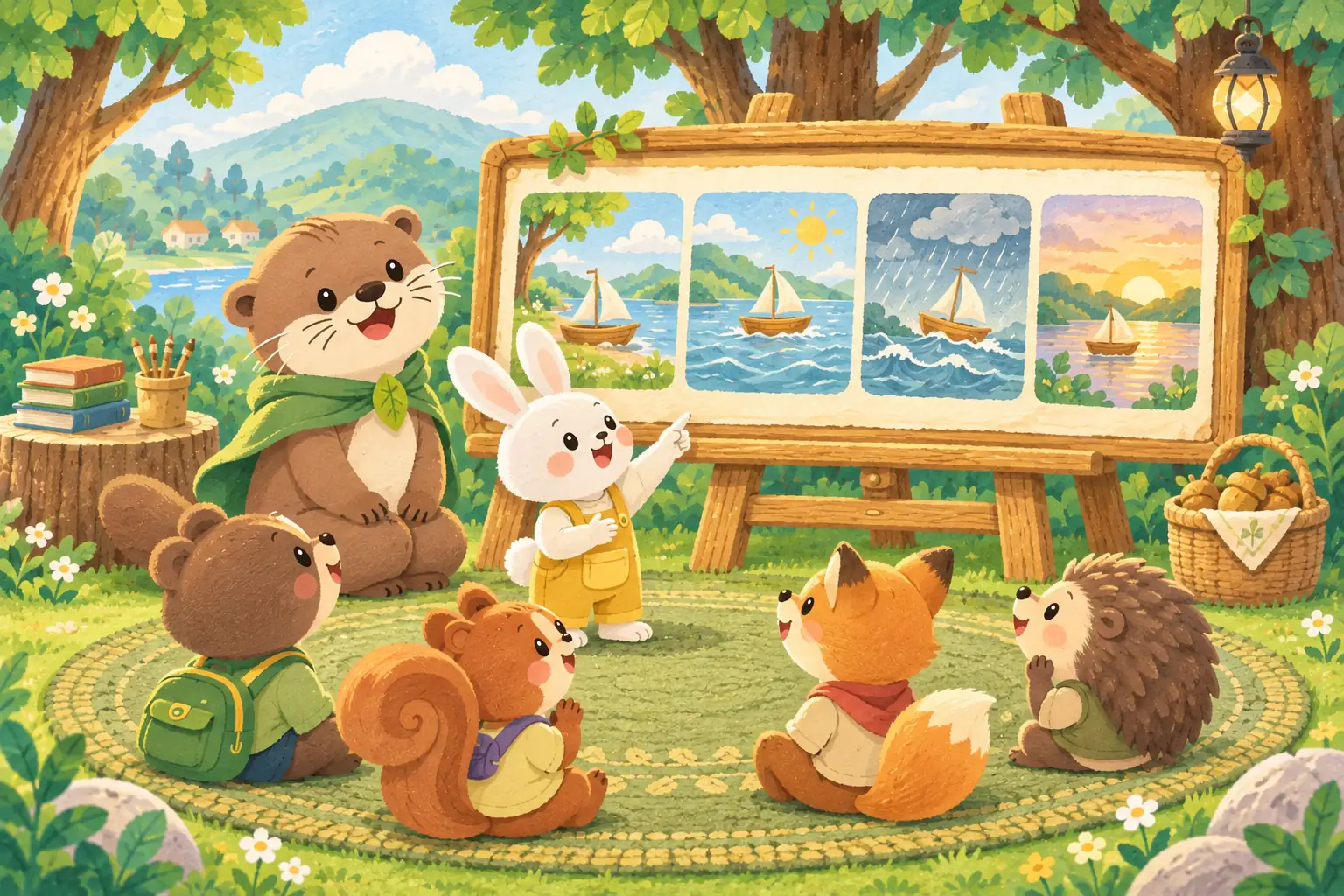
Teaching elementary students to tackle picture writing prompts means shifting their eyes from naming isolated nouns to connecting facial expressions, cause-and-effect clues, and spoken dialogue. Across Grades 1 through 3, oral picture talk and four-panel sequence writing form the most natural bridge between lively rug conversations and multi-sentence paragraphs. Below you will find a 4-step visual scanning routine, transition frames that retire repetitive *"and then"* chains, an original wordless four-panel comic ready to project tomorrow morning (complete with Grade 1, Grade 2, and Grade 3 mentor drafts), and 20 everyday school and home story scenarios.
How to Teach Picture Writing Prompts Beyond Naming Objects: The 4-Step Scan
When six- and seven-year-olds look at a busy illustration, their eyes bounce randomly across the page; giving them a predictable four-stop scanning path turns scattered inventory lists into grounded opening sentences. Every primary teacher has heard a student walk up to the easel, point at an illustration, and announce, *"There is a tree, a bench, a little bear, and a squirrel. The end."* Rarely is that a vocabulary problem—students simply have not learned where to look first, second, and third. Analyzing wordless picture-book instruction, literacy researcher Frank Serafini (2014) demonstrated that guiding young readers systematically from environmental setting clues to character posture, facial tension, and spatial interaction unlocks narrative inference—directly supporting primary ELA speaking and narrative writing standards.
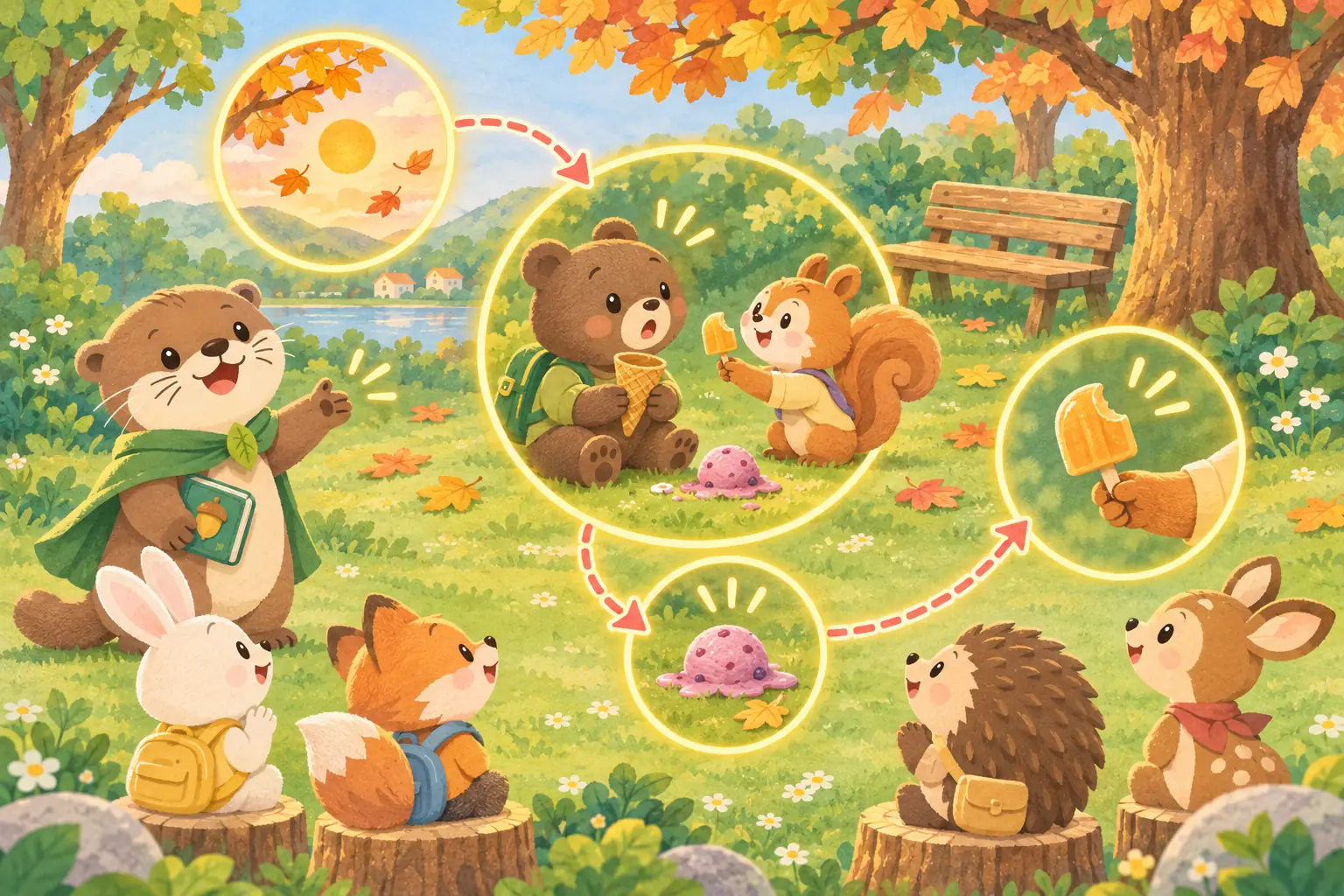
Take the autumn park scene above. Instead of asking for a full story right away, invite your class to hold up thumb-and-finger "magnifying glasses" and sweep through four numbered stops together: start up in the amber sky and falling leaves to anchor autumn late afternoon, move dead-center to meet Barnaby Bear and Pip Squirrel, zoom in on Barnaby's wide open mouth and the scoop on the grass to spot the sudden problem, and trace Pip's outstretched paw to uncover the kind solution. Four stops, and the whole story spine stands up on its own.
| Scan Order | Where the Magnifying Glass Zooms | Teacher Prompt on the Rug | Student Upgrade From Noun List to Story Line |
|---|---|---|---|
| Step 1: Sky & Setting | Sun height, clouds, falling leaves, room decor | *"Look at the sky and trees—what season, time of day, and place is this?"* | *"On a breezy autumn afternoon, Barnaby Bear and Pip Squirrel strolled through the park."* |
| Step 2: Central Star | The 1–2 largest figures interacting center-stage | *"Who stands right in the middle? Let's give each character a quick, easy name!"* | *"Barnaby carried a tall strawberry ice-cream cone he had just bought."* |
| Step 3: Brows & Mouth | Furrowed brows, gasped mouth, sweat drops, raised hands | *"Zoom in on Barnaby's eyebrows and mouth—what surprise just happened?"* | *"All of a sudden, the scoop slipped off the cone onto the grass, and Barnaby's eyes filled with tears."* |
| Step 4: Corner Clues | Nearby friend's hands, dropped items, background shifts | *"What is Pip holding beside him, and what thoughtful move does he make?"* | *"Smiling warmly, Pip snapped his twin-stick orange popsicle in half so both friends could sit on the bench sharing a treat."* |
4-Step Picture Magnifying Glass Routine

1. Scan the Sky & Background: What time of day is it? What is the weather like? Where are we?
2. Meet the Main Characters: Who is at the center? (Give them short, easy-to-spell names first!)
3. Read Eyebrows & Hands: What are their faces and hands doing? What problem or surprise popped up?
4. Spot the Helper Clue: What is happening nearby? How does the problem get solved?

Writer's Rule: Skip starting with "There is a..." or "I see a..."—open with WHEN, WHO, and WHERE!
Turning a Single Picture Into a Full Story: Before-and-After Inference
A single-panel picture freezes only the middle second of an event; teaching children to rewind one second for the cause and fast-forward one second for the response grows a three-part story out of any still image. On primary writing benchmarks and morning journal sheets, young writers often glance at a single illustration and stop after two sentences because they only describe the visible present-progressive action while ignoring the invisible past and future.
Draw three horizontal boxes across your whiteboard and tape or project the picture inside the middle "Right This Second" box. Label the empty left box "1 Second Earlier (Why did this happen?)" and the empty right box "1 Second Later (What will they do next?)". Once students trace a puddle on a desk backward to *"an elbow bumping an uncapped water bottle"* and forward to *"grabbing paper towels together before the math notebook gets soaked,"* their paragraphs triple in depth. When students can infer cause and effect orally but still write bare five-word sentences, pair this three-box routine with our sentence expanding and vivid idiom guide to layer sensory verbs and sound words onto each frame.
| Single-Picture Scenario | 1 Second Earlier (The Cause) | Right This Second (Visible Faces & Clues) | 1 Second Later (Action & Feeling) |
|---|---|---|---|
| Spilled Water Bottle | Rushing out for recess, Leo's elbow bumped an uncapped bottle on his desk corner | Water races toward his open workbook while Leo gasps and lifts his pages with both hands | Desk partner Maya presses tissues down as a dam, they wipe the desk dry, and Leo clicks the cap shut tight |
| Sharing One Yellow Umbrella | Morning sunshine tricked Sam into leaving his raincoat at home before an afternoon downpour | Sam stands frowning at the walkway edge watching heavy rain until Mia jogs over waving a wide yellow umbrella | Walking shoulder to shoulder toward the bus loop, both friends laugh even with damp sneakers |
| Dropped Relay Baton | Runner #3 sprinted in fast while Runner #4 reached back a split second too early | The red plastic baton bounces toward the lane line as both teammates whirl around wide-eyed | Scooping the baton up without blaming each other, Runner #4 jets forward to loud sideline cheers |
| Fledgling Bird Under a Tree | Gusty overnight winds tilted a robin's nest high in the courtyard maple | A damp-feathered baby bird huddles in the clover while two students crouch at a respectful distance | Keeping hands off the bird, they fetch the science teacher and custodian to help return it safely |
Curing the "And Then" Trap: 4-Panel Transition Words and Dialogue Frames
Four-panel comic writing isn't really about listing what sits inside each box—it is about capturing what changed between Box 1 and Box 4 using position-specific transition phrases and one line of punctuated speech. In their meta-analysis of elementary writing instruction, Graham et al. (2012) confirmed that explicitly teaching text-structure scaffolds and planning strategies produces strong gains in primary writing quality. A four-panel strip naturally mirrors a classic four-beat story arc: Setup, Rising Action, Sudden Twist, and Resolution.
Read a stack of unguided Grade 2 comic drafts and you will meet this sentence cousin on half the pages: *"Ben was doing homework, and then the dog ran over, and then the worksheet ripped, and then Ben felt sad."* Flattening all four boxes behind *"and then"* drains every ounce of suspense out of Panel 3. Establish a cheerful class rule—at most one "then" per story—hand out the four-box signpost bank below, and ask students to give one character a spoken line with quotation marks in Panel 3 or Panel 4. By late Grade 3, those exact four panels expand seamlessly into multi-paragraph stories using the Story Mountain planner in our elementary narrative writing prompts guide.
| Panel Position | Narrative Job | "Goodbye And-Then" Transition Starters | Quick Craft Upgrade |
|---|---|---|---|
| Panel 1 (Setup) | Anchor time, place, named characters, and initial plan | *One sunny Saturday morning,* *Right after the recess bell,* *Late Friday afternoon,* | Name one weather or color detail to light the scene |
| Panel 2 (Build) | Show smooth progress or a tiny hint of trouble | *At first,* *Moments later,* *Step by step,* *Just as they were carefully...* | Pair two small physical verbs (*dug a hole and patted the soil*) |
| Panel 3 (Twist) | Drop in the surprise, mishap, storm, or mix-up | *All of a sudden,* *Out of nowhere,* *To their surprise,* *Worse yet,* | Describe a racing heart, wide eyes, or a shouted exclamation |
| Panel 4 (Landing) | Show the clever fix, final outcome, and lingering feeling | *Thankfully,* *Working together,* *At last,* *From that afternoon on,* | Close with one warm line of dialogue or quiet realization |
4-Panel Story Signposts (Desk Helper)

Panel 1 — Set the Time & Place:
- One breezy Saturday morning, ________ and ________ were out in the ________.
- Right after the dismissal bell rang, ________ headed toward ________ to ________.

Panel 2 — Move the Action Forward:
- At first, they carefully ________, and moments later they ________.
- Little by little, everything looked ready—just as ________ was about to ________...

Panel 3 — Drop the Surprise Twist:
- All of a sudden, dark clouds rolled in and ________!
- Worse yet, ________ accidentally slipped and ________!

Panel 4 — Solve It & Speak Up:
- Thankfully, ________ spotted a clever way to help by using ________.
- At last, ________ stood tall again! ________ grinned and said, "________!"

3 Easy Ways to Punctuate Dialogue (Grades 1–3):
1. Speaker Tag First: Leo let out a big breath and said, "Good thing you grabbed that towel!"
2. Action + Exclamation: Mia pointed toward the window and gasped, "Watch out! The flowerpot is tipping!"
3. Quiet Inner Thought: Looking at their finished poster, Sam thought, "Sharing markers made our picture twice as bright."
Ready-to-Project Wordless 4-Panel Comic and 20 Everyday Story Scenarios
Hunting down copyright-clean, text-free four-panel strips with genuine cause-and-effect problem solving eats up precious prep periods—so we illustrated the wordless woodland comic below to project straight onto your classroom board. Because the panels contain zero printed words or numbers, you can use the exact same image for Kindergarten/Grade 1 oral turn-taking, Grade 2 single-paragraph sequencing, or Grade 3 four-paragraph dialogue writing.
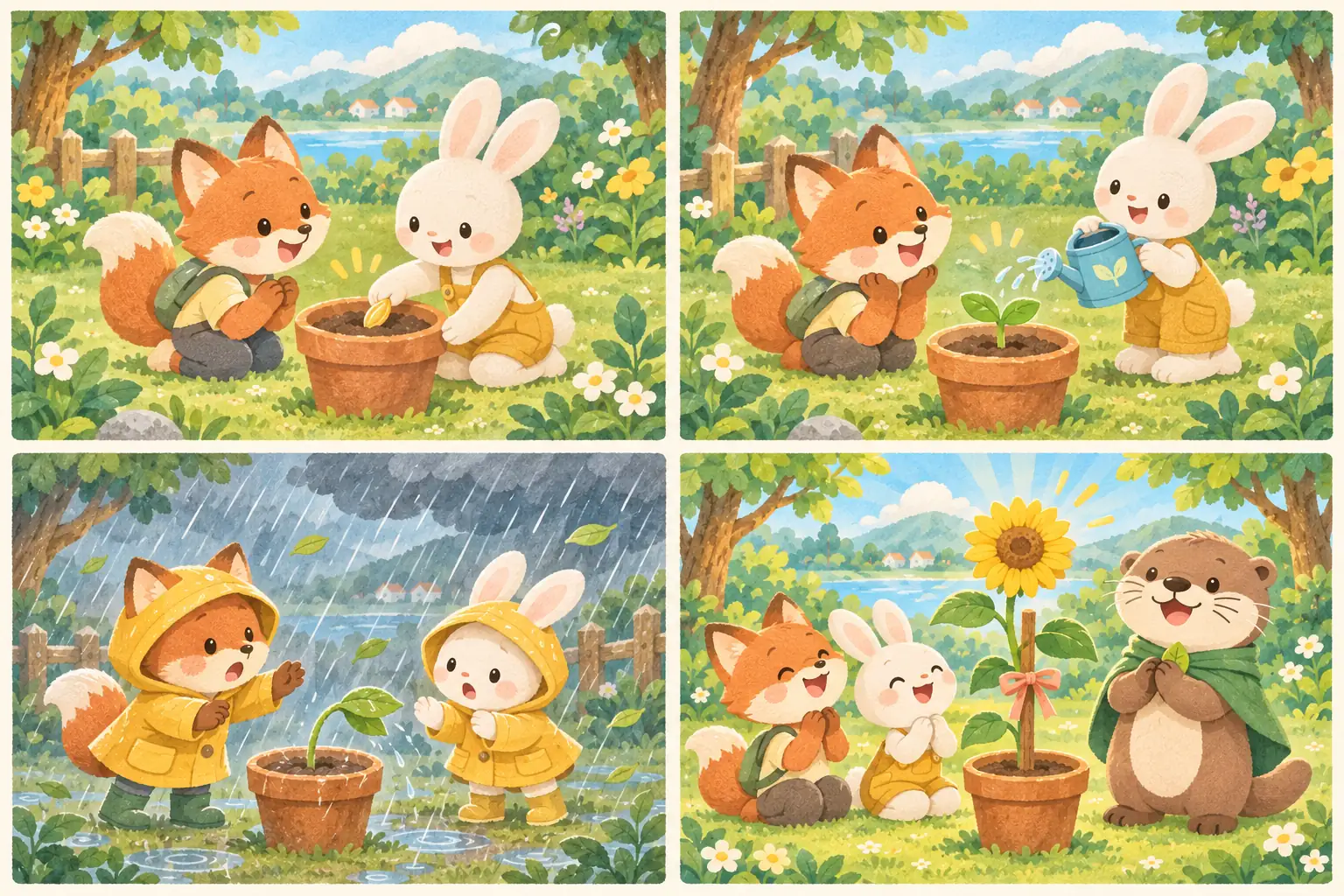
Try a two-stage reveal when projecting this sunflower strip: cover the bottom two panels with a sheet of paper or screen shade first and ask partners what Fox and Rabbit are doing in the garden. Next, uncover Panel 3's sideways rain and ask: *"Look closely at the green stem—what happened, and why are they sprinting outside in yellow raincoats?"* Finally, reveal Panel 4 and let students spot the wooden garden stake and ribbon tie beside the tall bloom so they see characters solving problems through teamwork rather than magic. Compare how expectations scale smoothly across Grades 1–3 on the exact same prompt:
[Grade 1 Emergent Sample | Goal: 3–4 complete sentences with brave phonetic spelling]
In the spring, Finn Fox and Ruby Rabbit planted a little seed in a pot. Every day Ruby used her blue watering can to give the green sprout a drink. All of a sudden, a big wind and rain storm blew the stem sideways, so they ran out in yellow raincoats! They tied the stem gently to a wooden stick, and when the sun came back, a giant yellow sunflower bloomed.

[Grade 2 Transition-Word Sample | Goal: Clear 4-panel transitions and cause-and-effect]
One sunny Saturday morning, Finn Fox and Ruby Rabbit teamed up in the school garden to fill a clay pot with soil and tuck a striped sunflower seed inside. Over the next week, a bright green sprout poked up, and Ruby watered it carefully every afternoon. Out of nowhere on Wednesday, dark clouds poured heavy rain and fierce wind bent the skinny stem nearly to the dirt! Thankfully, Finn had a smart idea—wearing their yellow raincoats, he pushed a sturdy wooden stick beside the plant while Ruby tied a soft ribbon figure-eight to hold it upright. By Friday morning, golden petals opened taller than their ears, and both friends beamed with pride.

[Grade 3 Multi-Paragraph & Dialogue Sample | Goal: 4 paragraphs, sensory verbs & punctuated speech]
Warm April sunshine spilled across the courtyard garden as Finn Fox and Ruby Rabbit crouched beside a terracotta pot. Finn scooped dark, crumbly soil with both paws while Ruby pressed a plump sunflower seed into the center and patted it snug.

A week later, two tiny green leaves uncurled toward the light. Every morning before the first bell, Ruby tiptoed outside with her sky-blue watering can. Watching droplets sparkle on the stem, she whispered to Finn, "Look! I think it grew another inch overnight!"

All of a sudden after lunch on Thursday, the sky turned slate gray and gusty rain slanted across the playground. Through the window, they spotted their slender sprout bowing dangerously low in the wind! Pulling on bright yellow raincoats, they dashed outside as Ruby called out over the patter, "Hurry, Finn! The stem is going to snap!"

Thankfully, Finn spotted a straight cedar stake beside the garden shed. He pressed the stake firmly into the wet soil while Ruby looped a cloth ribbon gently around the stem to splint it steady. Days later, beneath a clear blue sky, their rescued sunflower stood straight and crowned with blazing gold petals—proof that quick teamwork weathers any storm.
Whenever you need quick morning-work oral draws, Friday journal prompts, or stick-figure comic starters on the whiteboard, pull from these 20 four-panel scenarios grounded in everyday kid life. Around autumn cultural units, you can also pair Prompt 17 with our Mid-Autumn Harvest Moon folklore and family story lesson so students illustrate and narrate their own family traditions.
Theme 1: School Life & Helping Classmates (Prompts 1–5)
1. Forgotten Markers in Art Class: (1) Art poster project begins; Leo unzips backpack and realizes marker box is at home -> (2) Leo stares at blank paper afraid to start -> (3) Tablemate slides a full rainbow caddy right between their desks -> (4) Both finish vibrant posters and high-five.
2. Gusty Playground Leaf Cleanup: (1) Two helpers rake dry autumn leaves into a neat pile -> (2) One goes to grab the dustpan -> (3) A swirling gust scatters leaves everywhere -> (4) One holds the bin sideways downwind while the other sweeps cleanly inside.
3. Cafeteria Soup Spill: (1) Carrying a warm tray carefully down the lunch aisle -> (2) Stepping toward the class table -> (3) Foot catches an untied shoelace and soup sloshes onto the floor -> (4) Custodian and table captain help mop up, friend shares crackers, and laces get double-knotted.
4. Last Dinosaur Book in the Library: (1) Rushing to the display shelf during library checkout -> (2) Two hands grab the single copy of the new dinosaur atlas at once -> (3) Both tug slightly with stubborn frowns -> (4) They pull two beanbags side by side to read it together page by page.
5. Ice Pack Buddy Walk: (1) Tripping on the turf during gym tag and scraping a knee -> (2) Sitting up wincing while game pauses -> (3) Best friend offers a steady shoulder down the hall to the nurse's office -> (4) Nurse adds bandage and ice pack; buddy walks back carrying both water bottles.

Theme 2: Everyday Home & Family Moments (Prompts 6–10)
6. Crooked Sunny-Side-Up Surprise: (1) Waking early Saturday to help Dad make Mom breakfast -> (2) Carefully sliding toast and a fried egg onto a plate -> (3) Yolk slips sideways into a lopsided grin -> (4) Adding two ketchup dots for eyes makes Mom laugh out loud at the table.
7. Lights-Out Birthday Fakeout: (1) Whole family gathered around dinner table for Grandpa's birthday -> (2) Living room lights suddenly click pitch-black -> (3) Little brother gasps thinking a fuse blew -> (4) Mom walks in carrying a glowing candlelit cake as everyone sings.
8. Scrubbing Muddy White Sneakers: (1) Coming home Friday with sneakers caked in field mud -> (2) Sitting on a low porch stool Saturday with warm suds and a brush -> (3) Bristles flick a giant soap-bubble mustache right onto nose -> (4) Sun-dried shoes gleam bright white on Monday morning.
9. Grocery Produce Detective: (1) Tasked with finding three fruits on the family shopping list -> (2) Bananas and apples go smoothly into the cart -> (3) Staring up and down aisles unable to spot kiwis -> (4) Politely asking a store clerk in a green apron and checking off item #3.
10. Missing Bedtime Teddy Bear: (1) Brushing teeth at 8:30 PM and noticing bed pillow is empty -> (2) Checking under blankets and behind the desk -> (3) Hearing the laundry-basket click down the hall -> (4) Dad hands over a freshly washed, sun-warmed teddy bear just in time for sleep.

Theme 3: Nature Curiosities & Animal Encounters (Prompts 11–15)
11. Ant Bridge Over a Sidewalk Puddle: (1) One tiny ant discovers a cracker crumb near the walkway -> (2) Taps antennae to summon three ant helpers -> (3) A rain puddle blocks their path home -> (4) A child gently lays a dry oak leaf across the water as a bridge and watches quietly.
12. Classroom Window Chrysalis: (1) Spotting a striped caterpillar munching milkweed in an observation jar -> (2) Sketching daily observations without tapping the glass -> (3) Caterpillar hangs completely still inside a jade-green chrysalis -> (4) Two weeks later an orange monarch spreads dry wings and flutters into the sky.
13. Squirrel's Forgotten Acorn: (1) Squirrel buries plump acorns beside a park bench in October -> (2) Winter snow blankets the grass; squirrel digs three empty holes -> (3) Spring thaw melts snow away -> (4) A tiny green oak seedling sprouts right where the forgotten acorn slept.
14. Sandcastle vs. Rising Tide: (1) Siblings sculpt a tall four-tower sandcastle decorated with shells -> (2) Stepping back to admire the seashell drawbridge -> (3) Foamy waves creep closer and lick the front wall -> (4) Digging a deep moat channels seawater around the castle long enough for a family photo.
15. Red Balloon in the Park Maple: (1) Little sister's wrist loop slips and red balloon floats upward -> (2) String tangles on a high maple branch; chin starts wobbling -> (3) A curious blue jay hops out to inspect the ribbon -> (4) Breeze + nudge frees the string right into big sister's waiting hands.

Theme 4: Celebrations & Conquering Jitters (Prompts 16–20)
16. Two-Wheeler Let-Go Moment: (1) Training wheels come off; gripping handlebars stiffly on the blacktop -> (2) Mom jogs alongside holding the back of the seat -> (3) Glancing sideways mid-pedal and realizing Mom is cheering twenty feet back -> (4) Cruising a full balanced loop into the breeze.
17. Harvest Moon Behind the Clouds: (1) Carrying folding chairs outside to spot the autumn full moon -> (2) Thick gray clouds hide the entire night sky -> (3) Sharing sliced pears and riddles patiently on picnic blankets -> (4) Night breeze parts the clouds to reveal a glowing golden moon.
18. Shy School Craft-Fair Table: (1) Setting up handmade bookmarks at the school charity market -> (2) Ten minutes pass while shoppers walk past silent, shy sellers -> (3) Drawing a bold colorful sign and practicing a friendly greeting -> (4) Younger kids crowd around and coins clink into the animal-shelter jar.
19. Upside-Down Welcome Banner: (1) Taping up a homemade "Welcome Grandma!" doorway banner -> (2) Standing on tiptoe to press the corners tight -> (3) Stepping back to see half the letters hanging upside down -> (4) Grandma laughs that upside-down letters mean "head-over-heels happy" and hugs everyone.
20. Recorder Concert Squeak Recovery: (1) Standing on risers under bright gym lights for spring music night -> (2) Nervous fingers miss a hole on measure two—loud squeak! -> (3) Stand partner gives a calm encouraging nod on the beat -> (4) Taking a steady breath and playing the rest of the melody smoothly to warm applause.
From Partner Talk to Paper: A 40-Minute Primary Lesson and 3-Star Checklist
A 40-minute picture-writing block runs smoothly whenever you protect the sequence "whole-group scan -> partner oral rehearsal -> solo pencil time." Synthesizing experimental literacy studies, Graham and Hebert (2011) highlighted how tightly pairing structured oral discussion, reading inference, and writing reinforces comprehension in both directions. In Grades 1–3, saying the story aloud always comes before writing it neatly: once a child has told all four panels to an elbow partner, working memory only has to manage handwriting and spelling rather than inventing plot and phonics at the exact same second.
| Lesson Window | Instructional Phase | Teacher Focus | Concrete Student Output |
|---|---|---|---|
| Minutes 00–08 | Masked Clue Warm-Up | Cover half the image or Panel 3; guide the 4-Step Scan and list 5 anchor words on the board | Class names the setting, characters, and 3 vivid action verbs |
| Minutes 08–18 | Partner Relay Storytelling | Partner A tells Panels 1–2, Partner B tells Panels 3–4 using at least two board transitions; swap! | Every child speaks a full beginning-to-end story aloud before touching a pencil |
| Minutes 18–33 | Independent Drafting | Circulate quietly; prompt phonetic sound-stretching on tricky words so writers never stall | Grade 1 writes 3–4 sentences; Grades 2–3 draft full 4-panel stories with 1 spoken line |
| Minutes 33–40 | 3-Star Check & Author's Chair | Invite 2 readers to stand beside the screen; listeners spot the strongest twist or dialogue line | Writers self-check mechanics and practice side-standing eye contact |
When coaching oral picture storytelling, skip memorized scripts and build three natural speaker habits: stand slightly angled beside the screen so nobody's back blocks the art, drop into a slower suspenseful voice on Panel 3's twist, and land on the character's closing line instead of *"That's my story, bye."* Print this three-star detective strip right at the bottom of your writing paper so students inspect their own draft before turning it in:
3-Star Picture Story Check (Before You Turn It In!)

Star 1 — Complete Story Arc:
[ ] I named WHEN, WHO, and WHERE in my opening sentence.
[ ] I told what happened and how the problem got solved (not just "I see a...").

Star 2 — Smooth Transitions & Voice:
[ ] I used transition starters like "All of a sudden," "Worse yet," "Thankfully," or "At last."
[ ] The word "then" appears at most ONCE in my whole story!
[ ] One character speaks out loud using quotation marks (" ").

Star 3 — Primary Paper Mechanics:
[ ] Every sentence starts with a capital letter and leaves clear finger spaces.
[ ] Periods, question marks, and exclamation points sit neatly on the baseline.
[ ] I stretched out tricky words phonetically and circled any spelling I want to double-check.FAQ
How do I help first and second graders stop writing "I see a tree and a bear" during picture writing?
Affirm their careful observation first, then ask three inference questions that turn static nouns into plot. Zoom in on eyebrows and mouths to ask how the character feels right now, scan the ground or hands to guess what happened one second ago, and ask what a helpful friend would do next. Linking those three answers builds a complete beginning-middle-end story.
Which transition words stop students from connecting every 4-panel comic frame with "and then"?
Post a four-panel signpost bank on the board: Panel 1 uses time openers (One crisp Saturday morning, Right after the recess bell), Panel 2 uses action movers (At first, Moments later, Just as they were...), Panel 3 uses problem-turn signals (All of a sudden, Unexpectedly, Worse yet), and Panel 4 uses resolution closers (Thankfully, In the end, From that afternoon on). Cap the whole draft at a single "then."
How can emergent Grade 1 writers tackle picture writing prompts before they spell fluently?
Prioritize complete oral sentences and brave phonetic spelling over perfect orthography in early first grade. Have partners point to the picture and rehearse "Who is doing what, and where?" aloud first. On paper, encourage students to stretch unfamiliar words phonetically and circle tricky spellings to check later so dictionary hunts never interrupt their story flow.
What delivery habits help primary students share picture stories aloud with confidence?
Coach three concrete habits: stand slightly to one side of the screen or easel so classmates can see the illustration, slow down and lift vocal expression during the Panel 3 surprise or character dialogue, and finish on a character's spoken line or warm realization rather than trailing off with "That's all, I'm done."
Sources
- Exploring Wordless Picture BooksThe Reading Teacher2014
- A meta-analysis of writing instruction for students in the elementary gradesJournal of Educational Psychology2012
- Writing to Read: A Meta-Analysis of the Impact of Writing and Writing Instruction on ReadingHarvard Educational Review2011